Real AI-generated curriculum

See what your child’s
quarter looks like

ELesson plans below were generated in minutes — a parent entered some info, picked courses, and the AI built the entire quarter. Pick a sample student to explore.

Grade 11, Quarter 4 — Modern Critiques and Medieval Systems

A thematic quarter linking the illusions of the Jazz Age to the power structures of the medieval world. The English course anchors around The Great Gatsby and a multi-stage research paper; World History traces feudalism across Europe and Japan, then follows the Crusades and the Silk Road’s transformation of the world.

Grade: 11. Reading: one grade above. History: broad surveys. Theme: College prep. Model: Gemini (did we mention you get to choose the model? You do. We like Gemini but you can also pick Claude, or Xai and change it whenever you want). Every lesson description below is exactly what the AI produced.

Reading: The Great Gatsby by F. Scott Fitzgerald; selected scenes from The Crucible by Arthur Miller

Writing focus: Multi-stage research paper (4–6 pages) with thesis proposal, annotated bibliography, outline, draft, revision, and oral defense

Grammar: Periodic and cumulative sentences, logical fallacies, MLA citation mastery

The Great Gatsby — Close Reading
01Modernism and the American DreamWriting
Introduces the literary movement of Modernism, its historical context following World War I, and its skepticism toward traditional institutions. The central topic: the concept of the 'American Dream' and its critique in Fitzgerald's novel. The quarter-long research paper is introduced with its stages and expectations.
02Ch. 1: Narrative Voice and Point of ViewWriting
Analyzes Chapter 1 through the narrator Nick Carraway — evaluating his reliability, social position, and initial judgments of the other characters. Objectives: identifying key elements of narrative voice and understanding how a first-person narrator shapes perception. Introduces MLA citation fundamentals.
03Ch. 2: Symbolism of the Valley of AshesEvidence
Close reading of Chapter 2, focusing on the Valley of Ashes and the eyes of Doctor T. J. Eckleburg. Analyzes the setting as a symbol of moral and social decay beneath the glamorous surface of the Jazz Age. Introduces the periodic sentence structure.
04Ch. 3: Illusion, Reality, and Social ClassWriting
Examines the party scene in Chapter 3. Differentiates between perceptions and realities of Gatsby's social gatherings. Analyzes guest behavior and Nick's observations to understand the class dynamics and moral emptiness of the era. Begins identifying major themes for the research paper.
05Grammar Workshop: Periodic & Cumulative SentencesWriting
Formally defines and differentiates periodic sentences (main clause at the end) and cumulative sentences (main clause at the beginning). Using examples from Fitzgerald's prose, the student practices identifying and composing these structures to vary rhythm and emphasis in analytical writing.

Session 06 — Research Paper Stage 1: Thesis Proposal

Full generated lesson
Intro Welcome to Your Research Paper

Today, we transition from reading and initial analysis to the first formal stage of academic writing: building your research paper. The most critical step in this entire process happens today. A strong house needs a solid foundation, and a strong research paper needs a meticulously planned thesis proposal.

Today’s objectives are twofold:

  1. You will learn the components of a strong thesis proposal and draft one for your paper on The Great Gatsby.
  2. You will then begin reading Chapter 4, but with a new, focused lens — searching for evidence to support the argument you’ve just proposed.

This is where your unique interpretation of the novel begins to take shape. Let’s get started. 🎯

Content The Blueprint: What is a Thesis Proposal?

Before you write a single paragraph of your paper, you need a plan. A thesis proposal is that plan — a blueprint that outlines what you intend to argue and how you intend to prove it. It’s a short document that forces you to clarify your thinking before you get lost in the weeds of research and writing.

A strong thesis proposal generally contains three key elements:

  1. The Thesis Statement: The core of your entire paper, condensed into a single, powerful sentence. It is not a statement of fact; it is an arguable claim that you will defend with evidence.
  2. Explanation of Argument: A brief paragraph that elaborates on your thesis, touching upon the main points you will use to support your claim.
  3. Guiding Research Questions: 3–5 open-ended questions that your thesis attempts to answer, pushing beyond simple plot summary into the realm of analysis.

Think of it like a military strategy: The thesis is your objective. The explanation is your plan of attack. The research questions are the intelligence you need to gather. A good proposal now will save you countless hours of revision later.

Content Forging an Argument: Your Thesis Statement

The thesis statement is the most important sentence you will write for this paper. It must be specific, arguable, and focused.

A weak thesis is often a fact or a broad summary.

  • Weak: “The Great Gatsby takes place in the 1920s and is about the American Dream.”
    This is a statement of fact. It’s not arguable and gives the writer nothing to prove.

A strong thesis makes a specific, debatable claim about the text’s meaning or effect.

  • Stronger: “In The Great Gatsby, Fitzgerald uses the doomed relationship between Gatsby and Daisy to critique the American Dream, revealing it as a destructive illusion rooted in materialism rather than genuine happiness.”
    This is arguable, and it’s specific — focusing on a particular relationship and theme.
How to Brainstorm Your Thesis:

1. Start with a theme: Think about the big ideas (the American Dream, social class, the past, wealth, disillusionment).
2. Take a stance: What is Fitzgerald saying about that theme?
3. Connect it to the text: Through which characters, symbols, or settings? Your answer forms the backbone of your thesis.

📺 CrashCourse — Like Pale Gold: The Great Gatsby Part 1 (12 min)

Content Building the Case: Argument and Inquiry

Once you have a working thesis, the next step is to briefly map out how you’ll prove it and what questions will guide you.

The Explanation of Argument — briefly answer: “What evidence will I use to support this claim?” Your explanation might include points like:

  • Analyzing Gatsby’s transformation from the idealistic James Gatz to the wealthy Jay Gatsby, showing how his dream became corrupted by the need for wealth.
  • Examining Daisy as a symbol of the hollow, materialistic prize the dream has become.
  • Using the contrast between East Egg and West Egg to illustrate rigid social barriers.

Guiding Research Questions — these should stem directly from your thesis:

  1. How does Fitzgerald’s use of symbolism (the green light, the Valley of Ashes) reinforce his critique?
  2. In what ways does Nick’s narration shape the reader’s understanding of Gatsby’s dream?
  3. To what extent is Gatsby’s downfall personal versus societal?
  4. How does the novel define happiness, and why does it remain elusive?
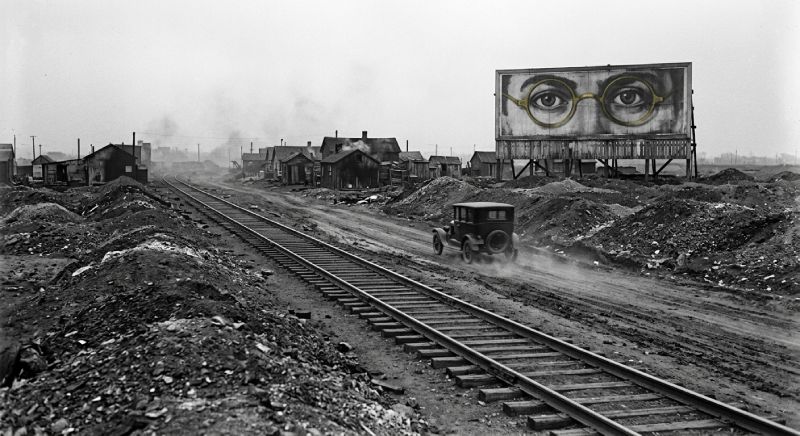
The Valley of Ashes — moral decay beneath glamour

The Valley of Ashes — a symbol of the moral decay underlying the era's glamour.

Writing Submit Your Thesis Proposal

It’s time to create your own thesis proposal for your research paper on The Great Gatsby. Construct a proposal that includes the following three components:

  1. Thesis Statement: A single, clear, arguable sentence that presents the central argument of your paper.
  2. Explanation of Argument: A paragraph (5–8 sentences) that elaborates on your thesis. Explain the main points you will use, referencing specific characters, settings, or thematic elements.
  3. Guiding Research Questions: A list of 3–5 open-ended, analytical questions that your paper will seek to answer — questions that require textual evidence and interpretation, not simple factual recall.
Student submission area
Write your thesis proposal here…
Reading Reading with Purpose: Chapter 4

Excellent work on the proposal. Now, let’s turn back to the novel with your new argument in mind.

📖 Please read Chapter 4 of The Great Gatsby.

As you read, actively hunt for evidence related to the thesis you just developed. Pay special attention to:

  • The List of Party Guests: What does this long, diverse list suggest about the society of the 1920s?
  • Gatsby’s Story: How does his account of his past align with the idea of the American Dream? Do you believe him?
  • Meyer Wolfsheim: What does his connection to Gatsby suggest about the source of Gatsby’s wealth?

Gatsby's extravagant parties were a spectacle of the Jazz Age's excess.

Gatsby’s extravagant parties — a spectacle of the Jazz Age’s excess.

Complete Foundation Laid

You’ve completed one of the most intellectually demanding parts of the writing process. By creating a strong thesis proposal, you’ve given yourself a clear map for the journey ahead. Every subsequent step — research, outlining, and drafting — will be easier and more focused because of the work you did today. ⭐

07Ch. 4: Deconstructing Gatsby’s PastEvidence
Analyzes the list of party guests and Gatsby's self-told life story. Evaluates the evidence he presents and Nick's skepticism. Objective: analyzing character development through direct and indirect characterization and questioning the authenticity of self-constructed identities.
08Vocabulary: Latin & Greek Roots of IllusionWriting
Etymology study of roots related to wealth and illusion: cred (believe), spec (see), luc/lum (light), fall (deceive), phant/phas (show, appear). Students define each root and provide example words with definitions.
09Research Paper Stage 2: Annotated BibliographyLong-form
Locating and evaluating scholarly secondary sources using academic databases. Compiles 3–5 relevant critical articles in correct MLA format, each with a summary and evaluation of usefulness.
10Ch. 5: The Dream Realized?Writing
The pivotal reunion between Gatsby and Daisy. Examines symbolism of weather, Gatsby's house, and the green light. Discusses whether reality can live up to five years of Gatsby's idealized dream — idealism versus reality at the novel's turning point.
11Rhetoric Workshop: Identifying Logical FallaciesMultiple choice
Introduces Ad Hominem, Straw Man, False Dichotomy, and Slippery Slope. The student learns to identify weak reasoning in arguments, both in literature and secondary sources.
12Research Paper Stage 3: Formal OutlineLong-form
Constructs a detailed outline with standard structure — thesis statement, topic sentences for each body paragraph, specific textual evidence and secondary source support. Creates a logical framework before drafting.
13Ch. 6: The Clash of Old and New MoneyEvidence
The party attended by Tom and Daisy Buchanan. Contrasts this event with earlier parties and examines the confrontation between Tom and Gatsby — the rigid social hierarchy of the 1920s and Gatsby's inability to penetrate 'old money.'
14Poetry: ‘Richard Cory’ by E.A. RobinsonWriting
Analyzes Robinson's poem on appearance versus reality and hidden despair. Draws thematic parallels between the poem's subject and Jay Gatsby, deepening understanding of the novel's central critique.
15Research Paper Stage 4: Drafting the IntroductionLong-form
Drafts the introduction and first body paragraph. The introduction must contain a compelling hook, necessary context, and thesis statement. The first body paragraph integrates textual evidence properly cited in MLA format.
16Ch. 7: The Climax at the PlazaWriting
Close reading of the novel's climax — the rising tension, the confrontation between Tom and Gatsby at the Plaza Hotel, and the tragic events that follow. Traces the complete collapse of Gatsby's dream, analyzing Fitzgerald's use of pacing and dialogue.
17Grammar Workshop: Advanced MLA CitationEvidence
Masterclass on MLA 9th edition: block quotes, indirect sources, and formatting the Works Cited page for books, journal articles, and web sources. Mastery of academic citation for scholarly writing.
18Research Paper Stage 4: Body ParagraphsLong-form
Develops the argument with a blend of textual evidence and secondary source analysis. Each paragraph maintains focus on its topic sentence and contributes directly to the thesis. Smooth transitions between paragraphs.
19Ch. 8: The Aftermath and TragedyWriting
Nick's final conversations with Gatsby and the events leading to his death. Themes of responsibility, consequence, and the carelessness of the wealthy. The tragic resolution of Gatsby's story and its commentary on the American Dream.
20Ch. 9: ‘So we beat on…’Writing
The novel's conclusion — Gatsby's funeral, Nick's final judgment of Tom and Daisy, and his concluding meditation on the past. Interprets the famous final lines and synthesizes overarching themes about hope, the past, and the elusive American Dream.
Research Paper & Capstone
21Completing the First DraftLong-form
Completes the first full draft including the conclusion, which synthesizes arguments and offers final insight into the topic. Ensures the Works Cited page is complete and correctly formatted.
22Introduction to The CrucibleWriting
Transitions to Arthur Miller's The Crucible — the historical context of the Salem Witch Trials and the allegorical context of McCarthyism. Selected scenes from Act I focus on initial accusations and social pressures within the Puritan community. Draws connections to Gatsby's themes of hierarchy, illusion, and moral corruption.
23Poetry: ‘The Second Coming’ by W.B. YeatsWriting
Dissects Yeats’s imagery of chaos and societal collapse. Connects the poem's tone and themes to the post-war disillusionment that permeates Gatsby and the breakdown of order in The Crucible.
24Self-Revision and EditingEvidence
Critical self-review using a formal revision checklist: macro level (thesis, argument, structure, evidence) and micro level (clarity, conciseness, grammar, MLA formatting). Shifting from writer to editor.
25The Crucible and Flawed LogicEvidence
Selected scenes from Acts II and III — courtroom proceedings and John Proctor's struggle. Identifies specific logical fallacies (appeal to authority, circular reasoning) used to justify persecution, connecting back to the earlier rhetoric workshop.
26Vocabulary: Roots of Power and JusticeWriting
Etymology of roots related to power, law, and justice: jus (law), dic/dict (say), pot/poss (power), leg (law), vindic (avenge, defend). Each root defined with example word and sentence relevant to the readings.
27Final Polish and SubmissionLong-form
Line-editing for style, proofreading, and final verification of all citations and formatting. The objective: submit a piece of scholarly work that reflects the student’s best analytical and writing abilities.
28Creative Writing: Modernist PoetryLong-form
An original poem (10–20 lines) employing Modernist techniques — fragmentation, stark imagery, free verse — exploring a theme from Gatsby or The Crucible. Understanding literary style through creative application.
29Capstone Prep: Oral Presentation OutlineLong-form
Condenses the research paper into a 5–7 minute oral presentation. Creates a speaking outline — not a script — that presents the thesis, summarizes key supporting points, and anticipates questions.
30Quarter 4 Capstone: Oral DefenseWriting
Delivers the oral presentation and responds to analytical questions testing depth of understanding and rigor of argument. Demonstrates mastery of the material and cultivates skills in scholarly discourse.

Era: Comparative Feudalism and Global Exchange

Arc: From a comparative analysis of feudal power structures in Medieval Europe and Japan to the major points of conflict and connection between civilizations — the Crusades, the Silk Road, and the Black Death

Key events: Battle of Hastings, the Crusades, the Magna Carta, Bushido vs. Chivalry, the Silk Road, Marco Polo

Comparative Feudalism
01The Rise of FeudalismWriting
Opens with a Socratic question: “After the Western Roman Empire collapsed, if you were a small landowner in Gaul in 600 AD, what would be your greatest fears?” Explores the fragmentation of power, cessation of trade, and constant invasions that gave rise to feudalism — a web of personal, reciprocal loyalties centered on land in exchange for military service. Includes primary source analysis of a feudal oath of fealty.
02The Norman Conquest of 1066Evidence
The succession crisis: Edward the Confessor dies childless, three men claim England's throne. Analyzes Harold Godwinson, William of Normandy, and Harald Hardrada. Military tactics at Stamford Bridge and Hastings. Primary source: the Bayeux Tapestry as Norman propaganda — how does it portray each side?
03Manorialism: The Medieval EconomyDiagram
The economic engine of feudalism: manor layout, three-field crop rotation, the hierarchy of lord, free peasant, and serf. Clarifies obligations flowing both directions — labor and fees upward, protection downward. Emphasizes the self-sufficient but static nature of the manorial economy.
04The Code of ChivalryWriting
A paradox: “Medieval knights were professional soldiers trained for brutal warfare, yet we picture them as courteous protectors. How?” Analyzes chivalry as an evolving set of ideals — prowess, loyalty, courtly love — and the gap between the ideal and the brutal reality. Compares chivalry to the Roman concept of virtus.
05The Magna Carta: Challenging the KingWriting
“Imagine a king who can tax you at will and imprison you without trial. What recourse would you have?” King John, the barons' revolt, and the 1215 document that was not initially about universal rights but became a cornerstone of English law. Primary source analysis of key clauses on due process and consent.
06Japanese Feudalism: Shoguns and SamuraiDiagram
Transitions to Japan: “While Europe built its lord-and-vassal system, a parallel structure emerged across the world. Why?” The decline of the imperial court, the rise of warrior families. Defines emperor, shogun, daimyo, samurai. Establishment of the Kamakura Shogunate in 1192.
07Manor vs. Shōen: Feudal Economies ComparedWriting
Point-by-point comparison of European manors and Japanese shōen estates: labor systems, obligations, ruling class lifestyle, and the weakness of central authority that made both necessary. Four comparative dimensions analyzed side by side.
08Bushido vs. Chivalry: Warrior Codes ComparedEvidence
“A knight and a samurai meet on a hypothetical battlefield. Beyond armor, what codes would guide them?” Analyzes Bushido's tenets using primary source excerpts. Three key distinctions: absolute loyalty vs. complex loyalties, acceptance of death vs. survival and ransom, Zen Buddhism vs. Christianity.
09Unit Assessment: Comparative FeudalismUnit test
Summative assessment covering the political, social, and economic structures of European and Japanese feudalism, with emphasis on the ability to compare and contrast the two systems.
Conflict and Exchange
10The Causes of the CrusadesWriting
“What could motivate tens of thousands of people to march thousands of miles to fight in a foreign land?” Analyzes Pope Urban II's speech at Clermont through multiple lenses: religious piety, geopolitical goals, economic motives, and social pressures. Primary source analysis of different accounts of the speech.
11The First Crusade: People’s Crusade to JerusalemEvidence
Distinguishes the disastrous People's Crusade from the Princes' Crusade. Traces the route through Byzantium and Anatolia to the bloody capture of Jerusalem in 1099. Multiple perspectives: reads excerpts from both Christian (Fulcher of Chartres) and Muslim (Ibn al-Qalanisi) chroniclers describing the same events.
12Richard the Lionheart vs. SaladinWriting
Two legendary commanders. Analyzes their backgrounds, leadership styles, and strategic objectives. The Siege of Acre, Battle of Arsuf, and the strange dynamic of mutual respect between mortal enemies. Concludes with the treaty leaving Jerusalem in Muslim hands but guaranteeing Christian pilgrim access.

Session 13 — The Legacy of the Crusades

Full generated lesson
Intro Welcome to Your Lesson

Let’s dive into a fascinating historical question today. For nearly 200 years, European knights and pilgrims marched to the Middle East with the goal of capturing and holding the Holy Land. In the end, they failed to achieve that primary objective permanently. So, what was the point? Were the Crusades just a colossal failure?

That’s the question we’re going to tackle. We’re going to look beyond the battlefield and analyze the long-term, often unintended, consequences of this monumental clash of civilizations.

🎯 Today’s Objective: You will analyze the economic, political, cultural, and social consequences of the Crusades to form a nuanced argument about their ultimate historical significance.

Content Economic Reshaping of Europe

Before the Crusades, trade between Western Europe and the Middle East was minimal. The Crusades changed that dramatically.

The Rise of Italian City-States — Transporting tens of thousands of soldiers across the sea was a massive logistical challenge. Venice, Genoa, and Pisa were perfectly positioned to profit. They built vast fleets, charged exorbitant fees, and established trading posts in the Crusader states.

A Flood of New Goods — Knights developed a taste for Eastern luxuries:

  1. Spices: Pepper, cloves, cinnamon — highly sought-after to preserve food and improve taste.
  2. Textiles: Fine silks, damasks, and muslin far superior to coarse European woolens.
  3. New Foods: Sugar (a rare luxury), lemons, apricots, and figs.

This influx created new markets and a powerful new merchant class, helping fuel a commercial revolution that would slowly chip away at the land-based feudal economy.
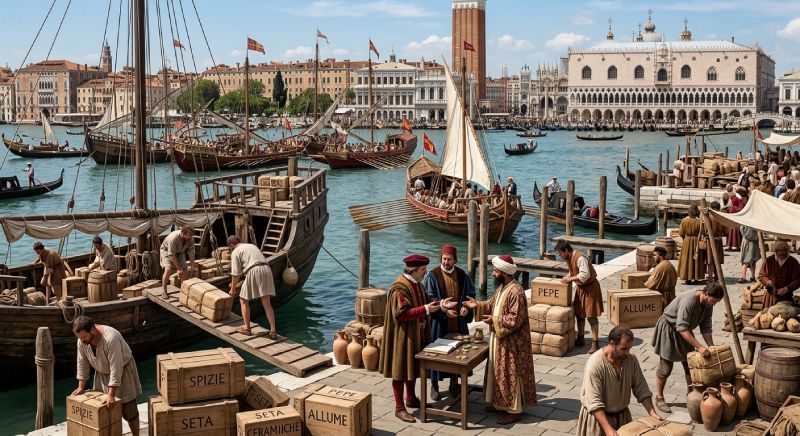
Venetian ports thrived, connecting Europe to the trade goods of the East.

Venetian ports thrived, connecting Europe to the trade goods of the East.

Content Political Power Shifts

Weakening of Feudal Lords — Going on crusade was incredibly expensive. Many lords sold their lands or took massive loans. Thousands never returned. When a lord died without an heir, his lands often reverted to the king — repeated across Europe for two centuries, consolidating power in monarchs’ hands.

Strengthening of Monarchies — With more land, more tax revenue, and fewer powerful vassals to challenge them, kings began building the centralized administrations that would eventually become modern nation-states.

The Decline of the Byzantine Empire — Perhaps the most ironic consequence: the Fourth Crusade was diverted to attack and brutally sack Constantinople in 1204 — the very Christian empire the First Crusade was meant to help. The empire was permanently crippled, left vulnerable to the Ottoman Turks who would finally conquer it in 1453.
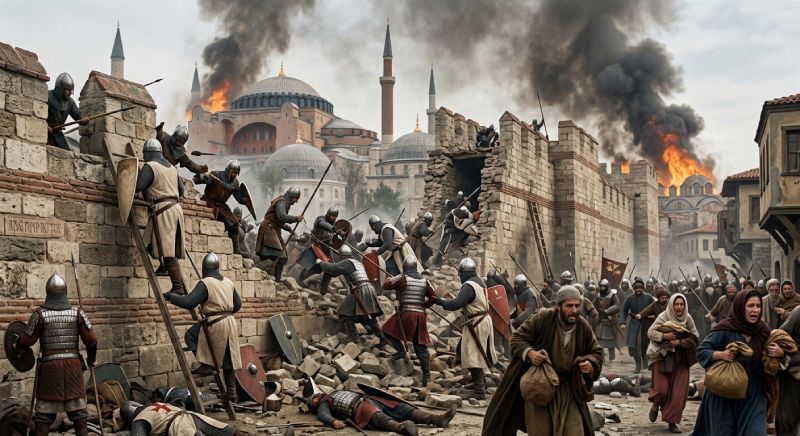
The Fourth Crusade's sack of Constantinople fatally weakened the Byzantine Empire.

The Fourth Crusade’s sack of Constantinople fatally weakened the Byzantine Empire.

Content A Bridge for Knowledge and Technology

The Islamic world was experiencing a Golden Age of science, medicine, and philosophy. They had preserved and built upon the works of the ancient Greeks, largely lost in the West. Through interactions in Crusader states, libraries in Spain, and trade, this knowledge began flowing into Europe.

Key Transfers of Knowledge:

1. Mathematics: Arabic numerals, algebra, and trigonometry replaced cumbersome Roman numerals.

2. Medicine and Science: Medical texts by Ibn Sina (Avicenna) contained detailed knowledge of anatomy, surgery, and pharmacology far more advanced than anything in Europe.

3. Philosophy: Aristotle’s works were reintroduced through Arabic translations and commentaries by Ibn Rushd (Averroes).

Practical technology was also exchanged: better shipbuilding techniques, the astrolabe and magnetic compass — laying essential groundwork for the future Age of Exploration.

📺 TED-Ed — The imaginary king who changed the real world (6 min)

Content The Social and Religious Scars

Not all consequences were positive. The Crusades left deep and lasting scars.

Christian-Muslim Relations — The rhetoric used to inspire crusaders often demonized Muslims, creating a narrative of religious hatred. The violence left a legacy of bitterness and mistrust that would persist for centuries.

Western vs. Eastern Christianity — The sack of Constantinople in 1204 made the schism between Catholic and Orthodox churches irreparable. For Eastern Christians, fellow Christians looting their holy city was an unforgivable betrayal.

Writing Synthesize Your Analysis

The Crusades ultimately failed in their primary goal of permanently securing the Holy Land for Christendom. So, were they just a failure? Or did they have other, perhaps unintended, consequences that reshaped the world?

Write a multi-paragraph essay (3–4 paragraphs) that answers this question. Your first paragraph should present a clear thesis statement. In the following paragraphs, use specific evidence from the lesson (economic, political, cultural, and social impacts) to support your argument.

Student submission area
Write your essay here…
Complete Lesson Complete

You’ve moved beyond a simple narrative of battles and explored the complex, multifaceted legacy of one of history’s most significant events. It’s a great reminder that the consequences of historical actions are rarely straightforward. ⭐

14Unit Assessment: The CrusadesUnit test
Summative assessment on causes, key events, and consequences of the Crusades, focusing on the ability to analyze motivations, compare perspectives, and evaluate long-term impact.
Global Exchange
15The Silk Road and the Pax MongolicaWriting
“For centuries, long-distance trade was dangerous. Then in the 13th century it exploded. What changed?” The Mongol conquests created the largest contiguous land empire and a zone of relative security. Maps major routes and key goods — but emphasizes that the most important things traded were ideas, technologies, and cultures.
16Marco Polo: Invaluable Source or Unreliable Narrator?Evidence
Historical debate: did Marco Polo actually visit China? Reads excerpts describing paper money, coal, and the Khan's court. Weighs arguments for authenticity (detailed descriptions of unknowns) against skepticism (omission of foot-binding, tea, the Great Wall). Practices evaluating primary sources and understanding historiographical controversy.
17Technology Transfer: Gunpowder, Compass, PaperWriting
“Imagine European warfare without gunpowder, or scholarship without paper.” Traces three innovations from China to Europe: gunpowder (rendering knight and castle obsolete), the magnetic compass (enabling the Age of Discovery), and paper and printing (laying groundwork for Gutenberg). For each, traces the diffusion path and analyzes the transformative impact.
18The Black Death: When Trade Routes Carry DiseaseLong-form
The dark side of global networks. Traces the plague from Central Asia along trade routes to Europe in 1347, killing 30–50% of the population. Analyzes profound consequences: labor shortages collapsing the manorial system, peasant revolts, crisis of faith, and widespread upheaval. Frames the Black Death as a major catalyst for the end of the Middle Ages.
19Unit Assessment: Global ExchangeUnit test
Summative assessment covering the Silk Road, Pax Mongolica, Marco Polo, cultural diffusion, and the Black Death — evaluating understanding of the causes and consequences of increased global connection.
20Capstone: Power, Illusion, and ExchangeLong-form
Synthesizes the entire quarter. “How do feudalism, the Crusades, and the Silk Road exemplify power, illusion, and exchange?” Compares decentralized feudal power with papal authority and merchant wealth. Analyzes the gap between ideals and reality in chivalry, Bushido, and the Crusades. Culminates in a final argumentative essay drawing from at least two units.

Grade 8, Quarter 1 — The Individual and the Natural World

A Montessori-inspired quarter built around self-directed exploration and real-world connections. The English course centers on Jack London’s The Call of the Wild and Emerson’s essays, with nature-based vocabulary, analytical grammar work, and a multi-step analytical essay woven throughout.

Grade: 8. Theme: Montessori — self-directed learning, real-world connections, nature-based exploration. The AI adapts its approach to the educational philosophy: fewer worksheets, more analytical writing and evidence gathering. Model: Claude.

General
01Journey into the Wild: Introduction to The Call of the WildWriting
Begin your exploration of Jack London’s The Call of the Wild by reading the first chapter. Focus on understanding the setting and main character, Buck, through the lens of interconnectedness between humans and nature. Reflect on how Buck’s early life connects to his environment, using a short written response to capture your initial thoughts. This lesson sets the foundation for analyzing themes of survival and connection throughout the novel.
02Buck’s Transformation: Reading and ReflectionWriting
Continue reading the next chapter of The Call of the Wild, focusing on Buck’s early challenges and changes. Consider how his relationship with humans and nature shapes his behavior. Write a short response exploring one key moment of transformation and its connection to the theme of survival. This builds on your initial impressions from the first lesson.
03Crafting Descriptions with Verbal PhrasesWriting
Explore the use of verbal phrases (gerunds, participles, infinitives) to enhance descriptive writing, using examples from The Call of the Wild. Practice integrating verbal phrases into your own sentences to describe a scene or character from the novel. Write a short response demonstrating this skill, focusing on a vivid moment from your recent reading. This lesson connects grammar to the detailed style of the text.
04Nature’s Role: Reading and Evidence GatheringEvidence
Read the next chapter of The Call of the Wild, paying close attention to how nature influences Buck’s journey. Collect evidence from the text by identifying three specific descriptions or events that highlight the power of the natural world. Record these examples with brief explanations of their significance to the theme of interconnectedness. This deepens your analytical skills through direct engagement with the text.
05Vocabulary of the Wilderness: Word StudyWriting
Dive into vocabulary from The Call of the Wild with a focus on words related to nature and survival. Study a curated list of 10 words drawn from your reading, exploring their meanings, roots, and usage in context. Write a short response using at least three of these words to describe a scene from the novel. Spelling List: primitive, instinct, wilderness, savage, endurance, perilous, dominion, cunning, adaptability, ferocity. This lesson builds language precision tied to the text’s themes.
06Analytical Essay: Proposing a Thesis on Nature and GrowthPaper: Thesis
Begin your analytical essay project, titled 'Nature’s Mirror: Reflecting Personal Growth,' by proposing a thesis statement about how nature influences personal growth in The Call of the Wild. Write a short response outlining your topic focus and a clear thesis statement. This step lays the groundwork for your essay, connecting directly to the novel’s themes of survival and interconnectedness. Alongside this, reflect briefly on a recent chapter to maintain reading progress.

Session 06 — Analytical Essay: Proposing a Thesis on Nature and Growth

Full generated lesson
Intro Welcome to Today's Lesson!

Hey, I’m excited to dive into today’s lesson with you! We’re starting a big project—an analytical essay titled Nature’s Mirror: Reflecting Personal Growth. Your essay will explore how nature shapes personal growth in The Call of the Wild by Jack London. Today, we’ll focus on crafting a strong thesis statement—the core idea that will guide your entire essay. We’ll also take a moment to reflect on a recent chapter to keep your reading on track. Let’s get started and build the foundation for an amazing piece of writing!

Reading Reading Reflection: Chapter Review

Let’s keep up with your reading of The Call of the Wild. Today, I’d like you to revisit Chapter 5, which you’ve recently read. Open your book to Chapter 5, pages 58-70 (depending on your edition, so check the chapter title if needed). As you reread or skim through these pages, pay close attention to how Buck’s experiences in the harsh wilderness continue to change him. Think about specific moments where nature challenges him and how he adapts. Jot down 2-3 quick notes about key events or changes in Buck that stand out to you. This will help with your essay ideas later!
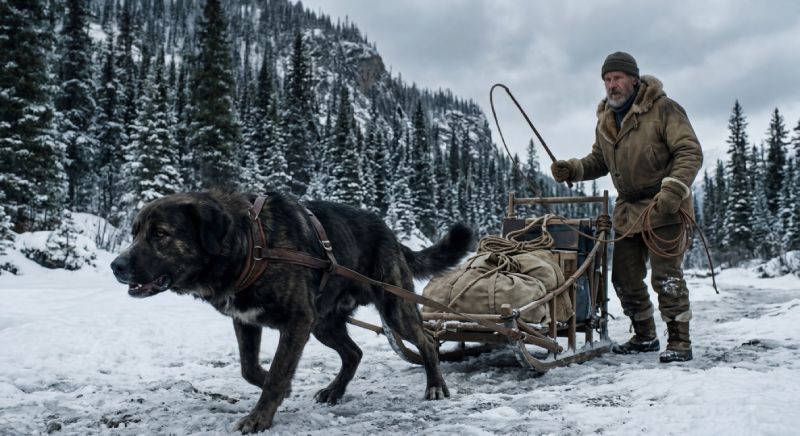
The frozen Yukon wilderness

The frozen Yukon wilderness that shapes Buck’s journey.

Content Understanding a Thesis Statement

Before we write, let’s talk about what a thesis statement is and why it’s so important. A thesis statement is the main idea of your essay—it’s a single sentence (or sometimes two) that tells your reader what you’re arguing or exploring. In an analytical essay like this one, your thesis should make a clear claim about a theme or idea in the book and hint at how you’ll support it.

Why does it matter? Your thesis is like a roadmap for your essay. It keeps you focused and tells your reader what to expect. For our topic, Nature’s Mirror: Reflecting Personal Growth, your thesis needs to connect nature to personal growth in The Call of the Wild.

Example Thesis Statement: Here’s a sample to guide you: 'In The Call of the Wild, Jack London uses the brutal natural environment to illustrate Buck’s personal growth, as his survival instincts awaken through physical challenges and loss.' Notice how this statement makes a specific claim (nature illustrates growth) and points to evidence (physical challenges and loss). Your thesis doesn’t have to look exactly like this, but it should be just as clear and focused. Let’s move on to crafting your own!
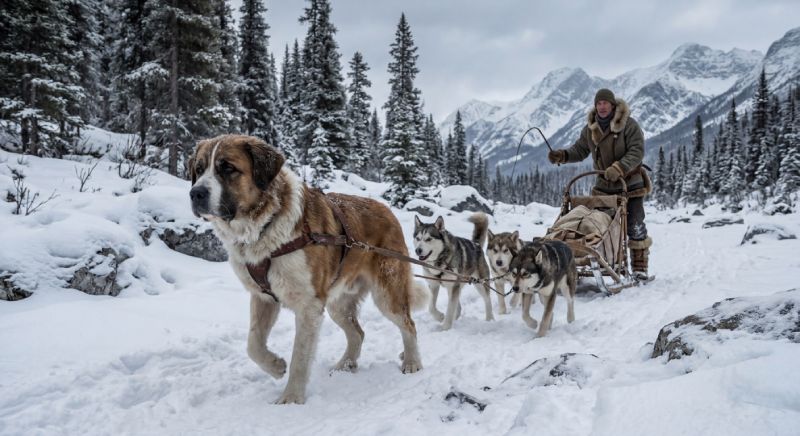
Buck faces the wilderness

Buck faces the wilderness — nature as teacher and mirror.

Writing Proposing Your Thesis Statement

Now it’s your turn! You’re going to propose a thesis statement for your essay on how nature influences personal growth in The Call of the Wild. Think about Buck’s journey—how does the natural world (the wilderness, weather, or animals) shape who he becomes? What specific changes or lessons does he learn because of nature? Use your notes from Chapter 5 and earlier readings to guide you. I’ll be looking at the clarity of your idea—don’t worry about perfect grammar or wording just yet. Write your response in the space below, following the prompt.

Your assignment

Write a short response (3-5 sentences) outlining your topic focus for the essay 'Nature’s Mirror: Reflecting Personal Growth.' Include a clear thesis statement (1-2 sentences) that explains how nature influences personal growth in The Call of the Wild. Be specific about what aspect of nature or growth you’ll explore.

Write your response here…
Complete Great Work Today,

Awesome job getting started on your analytical essay! Today, you revisited a key chapter in The Call of the Wild, learned what makes a strong thesis statement, and proposed your own idea for your essay. That thesis is the foundation of your project, and I can’t wait to see how you build on it. Take a moment to feel proud of laying this groundwork. Tomorrow, we’ll dive deeper into gathering evidence from the text to support your ideas. Keep up the great work!

07Survival in the Wild: Reading and ReflectionWriting
Read the next chapter of The Call of the Wild, focusing on Buck’s struggle for survival. Write a short response exploring how his actions reflect a connection to or conflict with nature. Consider how this relates to your emerging thesis for the analytical essay. This lesson continues to build your understanding of the novel’s central themes.
08Enhancing Detail with AppositivesWriting
Learn about appositives—phrases that rename or describe a noun—and how they add depth to writing, using examples from The Call of the Wild. Practice crafting sentences with appositives to describe characters or settings from the novel. Write a short response integrating at least two appositives to reflect on a key moment in your reading. This grammar focus enhances your descriptive skills.
09Analytical Essay: Creating a Formal OutlinePaper: Outline
Develop a formal outline for your analytical essay 'Nature’s Mirror: Reflecting Personal Growth,' structuring your argument about nature’s role in personal growth in The Call of the Wild. Include an introduction with your thesis, body sections with main points, and a conclusion. Write a short outline (1 page or less) to organize your thoughts. This step builds on your thesis proposal and prepares you for drafting. Also, briefly note a relevant quote from your reading to include in your essay.
10Poetry of the Wild: Reading and ResponseWriting
Explore a short nature poem from a provided collection, focusing on imagery and themes of interconnectedness with the natural world. Write a short response comparing the poem’s portrayal of nature to a specific moment in The Call of the Wild. This lesson broadens your perspective on literary expressions of nature while reinforcing thematic connections.
11Buck’s Journey Deepens: Reading and EvidenceEvidence
Read the next chapter of The Call of the Wild, focusing on Buck’s evolving relationship with his environment and other characters. Collect three pieces of evidence from the text that illustrate this development, explaining their relevance to themes of survival or connection. This lesson sharpens your ability to support ideas with textual evidence.
12Analytical Essay: Annotated BibliographyPaper: Bib.
Research and compile an annotated bibliography for your analytical essay 'Nature’s Mirror: Reflecting Personal Growth,' finding 3-5 sources related to themes in The Call of the Wild, such as nature’s influence or survival. For each source, write a brief summary (2-3 sentences) and explain its relevance to your essay. This step builds research skills and supports your argument with external perspectives. Also, briefly reflect on how a recent chapter connects to your essay focus.
13Vocabulary of Struggle: Word Study and SpellingWriting
Study a new list of 10 vocabulary words from The Call of the Wild, focusing on terms related to struggle and transformation. Explore meanings, roots, and context within the novel. Write a short response using at least three words to describe Buck’s challenges. Spelling List: toil, adversity, resilience, primal, subjugation, tenacity, vigor, relentless, prowess, instinctual. This lesson reinforces language tied to the novel’s themes.
14Verbal Phrases in Action: Grammar PracticeWriting
Revisit verbal phrases, focusing on how they create vivid descriptions in The Call of the Wild. Practice writing sentences using different types of verbal phrases to describe nature or character actions. Write a short response with at least three verbal phrases to reflect on a recent chapter. This reinforces grammar skills through direct application to the text.
15Analytical Essay: Drafting the EssayPaper: Draft
Draft the full body of your analytical essay 'Nature’s Mirror: Reflecting Personal Growth,' focusing on how nature shapes personal growth in The Call of the Wild. Write 4-6 paragraphs, including an introduction with your thesis, body paragraphs with evidence from the text, and a conclusion. Use direct quotes to support your points, building on your outline and bibliography. This step is the core of your writing project, emphasizing analysis and structure. Also, note a recent chapter’s relevance to your argument.

Session 15 — Analytical Essay: Drafting the Essay

Full generated lesson
Intro Welcome to Today's Writing Session

I’m excited to work with you today on a big step in your analytical essay, Nature’s Mirror: Reflecting Personal Growth. We’re diving into drafting the full body of your essay about how nature shapes personal growth in The Call of the Wild by Jack London. You’ve already created an outline and bibliography, so now it’s time to turn those ideas into powerful paragraphs. Today, you’ll write 4-6 paragraphs, including an introduction, body paragraphs with evidence, and a conclusion. Let’s make your argument shine with strong structure and direct quotes from the text!

Reading Review Key Chapters for Evidence

Before you start drafting, let’s revisit some key moments in The Call of the Wild to gather evidence for your essay. Open your copy of the book and skim through Chapter 3: The Dominant Primordial Beast (check the page numbers in your edition, likely around pages 35-50). Pay close attention to how Buck’s experiences in the wild shape his instincts and growth. Look for specific scenes where nature challenges him or changes his behavior. Take a few notes on quotes or events that connect to personal growth—maybe something from this chapter will strengthen your argument. Spend about 10 minutes refreshing your memory before moving on to drafting.

Content Structuring Your Analytical Essay

What Makes a Strong Analytical Essay? An analytical essay isn’t just a summary—it’s an argument. You’re showing how nature acts as a mirror for personal growth in The Call of the Wild. Your essay needs a clear structure to guide the reader through your ideas. Let’s break it down into parts so it’s easy to follow.

1. Introduction Paragraph Start with a hook—something interesting about nature or Buck’s journey to grab attention. Then, introduce the book and author briefly. End with your thesis statement, which is the main point of your essay. For example, your thesis might be: 'In The Call of the Wild, nature serves as a powerful force that mirrors Buck’s personal growth by stripping away his domesticated traits and awakening his primal instincts.' Make it specific and arg力がful.

2. Body Paragraphs (2-4 paragraphs) Each body paragraph should focus on one key idea that supports your thesis. Start with a topic sentence that states the main point of the paragraph. Then, provide evidence—use direct quotes from the text (include page numbers if possible). After the quote, explain how it connects to personal growth. For instance, if Buck learns to survive harsh winters, explain how that shows nature teaching him resilience. Aim for at least two strong pieces of evidence across your body paragraphs.

3. Conclusion Paragraph Wrap up by restating your thesis in a new way. Summarize your main points briefly, and leave the reader with a final thought—maybe a broader idea about how nature shapes us all. Keep it impactful but concise.

Take a moment to review your outline from earlier sessions. Does it match this structure? If not, tweak it before you start writing. I’m here to help your ideas flow!

Structuring the analytical essay

Turning observations into structured argument — the essay takes shape.

Writing Draft Your Analytical Essay

Now it’s time to write! You’re drafting the full body of your essay, Nature’s Mirror: Reflecting Personal Growth. Aim for 4-6 paragraphs total. Use the structure we discussed: an introduction with a hook and thesis, body paragraphs with topic sentences and evidence (direct quotes from The Call of the Wild), and a conclusion that ties it all together. Focus on how nature shapes Buck’s growth—dig into specific moments from the text. I’ll be looking at your content and how well you use evidence to support your argument. You’ve got this!

If you’re stuck, start with your strongest body paragraph from your outline. Build around a quote you already picked out. Write in a quiet space if you can, and don’t worry about perfection—this is a draft. We’ll revise later. Take about 30-40 minutes to get your ideas down.

Complete Great Work on Your Draft

Awesome job today! You’ve taken a huge step by drafting your analytical essay. I’m proud of how you’re putting together your thoughts on nature and personal growth in The Call of the Wild. Save your draft somewhere safe—we’ll revisit it soon for revisions to make it even stronger. Tomorrow, we might look at polishing your evidence or tightening your thesis. For now, take a break and feel good about the progress you’ve made. See you next time!

16Culmination of the Wild: Final ReadingWriting
Complete the final chapter of The Call of the Wild, reflecting on Buck’s full journey and the overarching themes of nature and survival. Write a short response on how the ending connects to the idea of interconnectedness between living beings. This lesson wraps up the novel while preparing for broader reflections.
17Self-Reliance: Introduction to Emerson’s EssaysWriting
Begin exploring Ralph Waldo Emerson’s essay 'Self-Reliance,' reading the opening sections. Focus on his ideas about individuality and connection to one’s inner nature. Write a short response reflecting on how these concepts relate to Buck’s journey in The Call of the Wild. This introduces a new text while maintaining thematic continuity.
18Appositives for Depth: Grammar ReinforcementWriting
Reinforce your understanding of appositives by identifying them in Emerson’s 'Self-Reliance' and creating your own. Write a short response using at least two appositives to describe a key idea or image from the essay. This lesson connects grammar to the reflective style of the new text.
19Analytical Essay: Final SubmissionPaper: Final
Finalize your analytical essay 'Nature’s Mirror: Reflecting Personal Growth,' polishing your draft on nature and personal growth in The Call of the Wild. Revise for clarity, ensure evidence supports your thesis, and check that your 4-6 paragraphs flow logically. Submit the final version as a culmination of your writing project. This step focuses on refinement and completion. Also, briefly note a connection to Emerson’s ideas if relevant.
20Emerson’s Nature: Reading and EvidenceEvidence
Read key sections of Emerson’s essay 'Nature,' focusing on his view of the natural world as a source of inspiration and connection. Collect three examples from the text that illustrate this perspective, explaining their significance. This lesson deepens your engagement with Emerson’s philosophy through textual evidence.
21Poetry of Connection: Analysis and CreationWriting
Read another nature poem from a provided collection, analyzing its imagery and themes of human-nature connection. Write a short response comparing the poem to ideas in Emerson’s essays. Then, create a brief original poem (4-8 lines) inspired by these themes. This lesson fosters both analysis and creative expression.
22Verbal Phrases and Appositives: Combined PracticeWriting
Combine your skills with verbal phrases and appositives to enhance descriptive writing, using examples from Emerson’s essays. Write a short response describing a concept or image from 'Nature' or 'Self-Reliance,' incorporating at least one verbal phrase and one appositive. This lesson integrates grammar skills for richer expression.
23Emerson’s Vision: Reflective WritingLong-form
Reflect on the core ideas of self-reliance and nature from Emerson’s essays, considering how they connect to your own experiences or observations. Write a longer response (1-2 paragraphs) exploring one key idea and its relevance to the theme of interconnectedness. This lesson encourages personal connection to the texts.
24Poetry as Reflection: Deep AnalysisLong-form
Analyze a third nature poem from a collection, focusing on how the poet uses language to convey interconnectedness. Write a longer response (1-2 paragraphs) exploring the poem’s themes and comparing them to either The Call of the Wild or Emerson’s essays. This lesson deepens your literary analysis through poetry.
25Themes of Connection: Comparative WritingLong-form
Reflect on the shared themes of human-nature connection across The Call of the Wild and Emerson’s essays. Write a longer response (1-2 paragraphs) comparing how each text portrays this relationship, using specific examples. This lesson synthesizes your understanding of the quarter’s readings.
26Grammar Review: Verbal Phrases and AppositivesLong-form
Review your mastery of verbal phrases and appositives by applying them to a reflective piece on the quarter’s themes. Write a longer response (1-2 paragraphs) about a key idea from your readings, incorporating at least two verbal phrases and two appositives. This lesson consolidates grammar skills in a meaningful context.
27Quarter 1 Unit Test: Themes and SkillsUnit Test
Demonstrate your understanding of the themes, texts, and skills covered in Quarter 1 through a comprehensive unit test. This session focuses solely on assessing your progress with The Call of the Wild, Emerson’s essays, analytical writing, and grammar concepts like verbal phrases and appositives. Your work throughout the quarter will guide your success in this evaluation of interconnectedness and personal growth themes.

Grade 7, Quarter 1 — Stories of Courage and Discovery

Meet Kayleigh — a 12-year-old visual learner from Pennsylvania who loves K-pop, horses, field hockey, and gymnastics. Her family takes an eclectic, interest-driven approach: flexibility is the philosophy. Some weeks are structured, some are exploratory. The AI wove her interests throughout — athletic analogies in science, K-pop cultural connections in world history, and The Hunger Games as the anchor novel in English. Three courses, 62 sessions across the quarter, zero lesson prep.

Grade: 7. Reading: one grade above level. Visual learner. Theme: Eclectic — interest-driven, secular, low-pressure. Grading: strict. The AI adapts tone to feel like “a cool aunt who happens to know a lot” — humor welcome, tangents welcome. Model: Claude.

Novel: The Hunger Games by Suzanne Collins

Writing focus: Character analysis, argumentative essays, comparative writing

Grammar: Sentence combining, paragraph transitions and flow

Extras: Poetry break on courage, detective fiction mini-unit (Sherlock Holmes), spelling integrated with reading themes

The Hunger Games — Close Reading
01Welcome to Stories of Courage — Introducing The Hunger GamesWriting
Begin our quarter exploring stories of courage and discovery by diving into The Hunger Games. Read Chapter 1 and meet Katniss Everdeen in District 12. Explore the world-building elements that Suzanne Collins uses to establish the dystopian setting. Discuss what makes a protagonist compelling and how authors hook readers from the first page. Create a visual character map showing Katniss’s relationships and her world.
🔤 Spelling: dystopian, protagonist, reaping, tesserae, mockingjay, district, capitol, tribute, arena, rebellion
💡 Use Kayleigh’s visual learning style by encouraging detailed character mapping with drawings and connections. Connect the theme of survival to her athletic background — how do athletes show mental toughness?
🧪 Materials: The Hunger Games by Suzanne Collins, notebook for character mapping, colored pencils or markers
02The Reaping and Rising Tension — Chapters 2-3Writing
Continue reading Chapters 2-3 of The Hunger Games, focusing on the reaping ceremony and Katniss’s sacrifice for Prim. Analyze how Collins builds suspense and emotional connection. Examine the concept of sacrifice in literature — when characters give up something important for others. Practice writing topic sentences that clearly state the main idea of a paragraph.
🔤 Spelling: dystopian, protagonist, reaping, tesserae, mockingjay, district, capitol, tribute, arena, rebellion
💡 Help Kayleigh connect Katniss’s protective instincts to her own experiences with younger teammates or friends. Emphasize clear topic sentence structure for future analytical writing.
🧪 Materials: The Hunger Games, writing materials
03Journey to the Capitol — Symbolism and ImageryQuiz
Read Chapters 4-5 focusing on Katniss’s journey to the Capitol and her first impressions of luxury versus poverty. Introduce the concept of symbolism in literature — how objects, colors, and settings represent deeper meanings. Create a visual symbol map showing the contrast between District 12 and the Capitol. Practice identifying symbols and their potential meanings.
🔤 Spelling: dystopian, protagonist, reaping, tesserae, mockingjay, district, capitol, tribute, arena, rebellion
💡 Use visual mapping extensively. Connect the wealth disparity theme to real-world examples Kayleigh can understand. Encourage her to think about symbols in K-pop videos or sports team colors.
🧪 Materials: The Hunger Games, art supplies for symbol mapping
04Training and Alliances — Character DevelopmentLong Writing
Read Chapters 6-7 covering Katniss’s training period and the complexity of forming alliances. Analyze character development — how authors reveal personality through actions, thoughts, and interactions with others. Examine the strategic thinking required in both the Games and in sports competition. Write a character analysis paragraph using textual evidence.
🔤 Spelling: dystopian, protagonist, reaping, tesserae, mockingjay, district, capitol, tribute, arena, rebellion
💡 Draw parallels between Games strategy and athletic competition strategy. Use Kayleigh’s sports experience to deepen understanding of alliance-building and competition psychology.
🧪 Materials: The Hunger Games, writing materials, character development worksheet
05Sentence Combining for Stronger WritingWriting
Focus on grammar skills by learning to combine simple sentences into more sophisticated structures. Use examples from The Hunger Games to practice coordination and subordination. Learn about compound and complex sentences, and when to use each type for better flow and emphasis. Practice revising choppy writing into smoother, more mature prose.
🔤 Spelling: dystopian, protagonist, reaping, tesserae, mockingjay, district, capitol, tribute, arena, rebellion
💡 Use concrete examples from the novel. Show how sentence variety affects the rhythm and pace of writing, similar to how music varies tempo and rhythm.
🧪 Materials: Grammar practice sheets, examples from current reading
06The Arena Begins — Conflict and SurvivalQuiz
Read Chapters 8-9 as the Games begin and Katniss faces immediate life-or-death decisions. Analyze different types of conflict in literature — person vs person, person vs society, person vs nature, and person vs self. Examine how authors use pacing and short, tense sentences during action scenes. Discuss survival instincts and decision-making under pressure.
🔤 Spelling: strategy, alliance, survival, conflict, tension, instinct, decision, pressure, competition, analysis
💡 Connect survival themes to outdoor activities and sports. Discuss how athletes make split-second decisions under pressure, similar to Katniss in the arena.
🧪 Materials: The Hunger Games, conflict analysis chart
07Poetry Break — Courage in VerseLong Writing
Take a break from the novel to explore how poets express themes of courage and resilience. Read selected poems about overcoming challenges and facing fears. Practice identifying poetic devices like metaphor, imagery, and repetition. Write a short poem about personal courage or a challenging moment, using concrete imagery and strong verbs.
🔤 Spelling: strategy, alliance, survival, conflict, tension, instinct, decision, pressure, competition, analysis
💡 Choose poems that resonate with athletic achievement or overcoming obstacles. Encourage Kayleigh to write about a moment from sports or performance where she showed courage.
🧪 Materials: Poetry collection, writing materials
08Fire and Tracker Jackers — Escalating DangerWriting
Continue with Chapters 10-11 as dangers intensify in the arena. Examine how authors escalate tension and raise stakes throughout a story. Analyze the role of natural elements as both obstacles and aids in survival stories. Practice writing action sequences with vivid verbs and sensory details. Discuss how fear affects decision-making.
🔤 Spelling: strategy, alliance, survival, conflict, tension, instinct, decision, pressure, competition, analysis
💡 Focus on vivid, active verbs that create excitement. Connect to her experience with fast-paced sports like field hockey where quick reactions matter.
🧪 Materials: The Hunger Games, action writing practice sheet
09Rue’s Alliance — Friendship and LossLong Writing
Read Chapters 12-13 focusing on Katniss’s partnership with Rue and the tragic consequences. Explore themes of friendship, loyalty, and loss in literature. Analyze how authors use younger characters to evoke emotional responses from readers. Examine the moral complexities of the Games and what they reveal about human nature.
🔤 Spelling: strategy, alliance, survival, conflict, tension, instinct, decision, pressure, competition, analysis
💡 Handle the emotional content sensitively. Connect to positive examples of mentorship in sports where older athletes help younger ones. Focus on the protective instincts and loyalty themes.
🧪 Materials: The Hunger Games, theme analysis worksheet

Session 09 — Rue’s Alliance: Friendship and Loss

Full generated lesson
Intro Welcome to Today’s Reading Journey

Hi Kayleigh! 🌟 Today we’re diving into some of the most emotionally powerful chapters in The Hunger Games. You’ll be reading about Katniss’s partnership with Rue and exploring how authors like Suzanne Collins create deep emotional connections between characters — and between readers and those characters.

Today’s Focus:

  1. Read Chapters 12-13 with attention to the alliance between Katniss and Rue
  2. Analyze how friendship and loyalty develop under pressure
  3. Explore how authors use younger characters to create emotional impact
  4. Connect these themes to real-world examples of mentorship and protection
  5. Practice your spelling words related to strategy and survival
  6. Write a thoughtful analysis about character relationships

This is heavy material emotionally, so take your time and remember that these themes of loyalty and protection show up in positive ways in real life too — like in sports teams where older players mentor younger ones! 💪

Spelling Spelling Practice — Strategy and Survival

Let’s start with your spelling words, which perfectly connect to today’s reading themes! These words all relate to the strategic thinking and survival elements you’ll see in Chapters 12-13.

Your Practice Steps:

  1. Look at each word carefully and notice the spelling patterns
  2. Write each word once neatly in your notebook
  3. Cover the word and write it again from memory
  4. Choose 4 words from the list and write a complete sentence using each one

Spelling Patterns to Notice:

  • Words ending in -sion (tension, decision) — these come from verbs
  • Words with -gy endings (strategy) — often from Greek roots
  • Double letters in the middle (alliance, pressure) — pay attention to these!
Spelling Words: strategy, alliance, survival, conflict, tension, instinct, decision, pressure, competition, analysis

These words will help you discuss the strategic elements of Katniss and Rue’s partnership! 📝

Reading Reading Chapters 12-13: The Alliance Forms

📖 Open The Hunger Games to Chapter 12

Reading Focus for Chapter 12:
As you read, pay special attention to:

  1. How Katniss first notices and observes Rue
  2. The moment when their alliance begins to form
  3. What each character brings to the partnership
  4. How their age difference affects their dynamic

Reading Focus for Chapter 13:
Watch for:

  1. How they work together and communicate
  2. The plan they develop and execute
  3. Moments that show their growing friendship
  4. The tragic turn of events and Katniss’s response

Active Reading Strategy:
As you read these chapters, jot down 3-4 notes about:

  • What makes Rue special or different from other tributes
  • How Katniss’s protective instincts emerge
  • Moments where you feel emotionally connected to either character

Emotional Preparation:
These chapters contain some sad and intense moments. Remember that authors include difficult scenes to help us understand important themes about human nature, loyalty, and love. Take breaks if you need them! 💙

Content Understanding Alliances in Literature

What Makes a Literary Alliance Meaningful?

In literature, an alliance is more than just two characters working together — it’s a bond that reveals important truths about human nature and relationships. Let’s analyze what makes Katniss and Rue’s partnership so powerful.

Types of Alliances in Stories:

  1. Strategic Alliances — Characters team up for mutual benefit or survival
  2. Protective Alliances — One character feels responsible for protecting another
  3. Friendship Alliances — Characters connect emotionally and genuinely care for each other
  4. Mentor-Student Alliances — An experienced character guides a less experienced one

Katniss and Rue’s relationship combines ALL of these elements, which is what makes it so emotionally complex and powerful.

Why Authors Create These Bonds:
Authors use alliances to:

  • Show character growth and development
  • Explore themes of loyalty, sacrifice, and love
  • Create emotional investment for readers
  • Demonstrate how people can maintain humanity even in terrible circumstances
  • Highlight the difference between survival and living with dignity

Real-World Connections:
Think about alliances in your own life — teammates who support each other in field hockey, older gymnasts who help younger ones learn difficult moves, or K-pop group members who protect and encourage each other. These same themes of loyalty and mutual support appear everywhere! 🤝
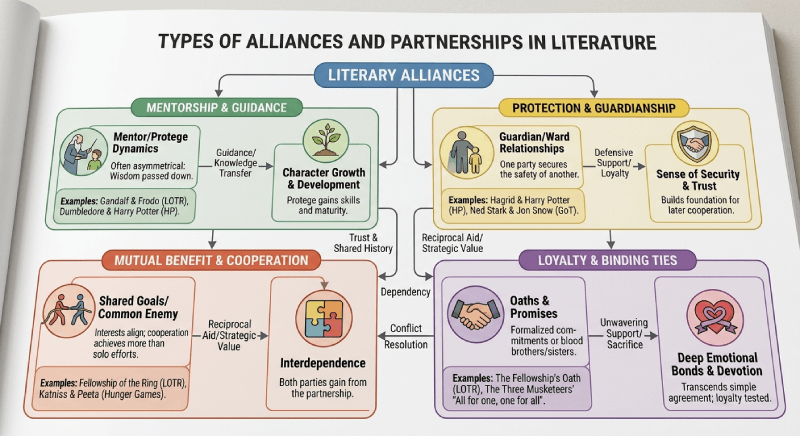
Types of Alliances and Partnerships in Literature — strategic, protective, friendship, and mentor-student

AI-generated visual — types of literary alliances mapped to the Katniss-Rue dynamic.

Content How Authors Use Young Characters for Emotional Impact

The Power of Youth in Storytelling

Suzanne Collins made a deliberate choice in creating Rue as a 12-year-old character. Authors often use younger characters to create specific emotional responses in readers. Let’s explore this technique.

Why Young Characters Create Strong Emotional Reactions:

  1. Innocence and Vulnerability — Young characters seem more innocent and defenseless, which triggers our protective instincts
  2. Lost Potential — We think about all the experiences and growth a young person should have ahead of them
  3. Unfairness — It feels fundamentally wrong when young people face adult dangers and responsibilities
  4. Hope and Tragedy — Young characters represent both hope for the future and the tragedy of that hope being threatened

Rue’s Specific Role:
Rue serves multiple purposes in the story:

  • She reminds Katniss (and readers) of Prim, creating personal stakes
  • Her youth highlights the cruelty and injustice of the Games
  • Her skills and intelligence challenge assumptions about age and capability
  • Her friendship with Katniss shows that human connection can survive even in the arena

Literary Technique — Symbolism:
Rue’s name means “regret” in French, but she also represents:

  • The mockingjay symbol (through her ability to communicate with the birds)
  • Innocence that shouldn’t be destroyed
  • Hope that people can still choose kindness
  • Sacrifice that inspires others to fight for what’s right

This technique of using younger characters to heighten emotional stakes appears in many great stories — it helps readers understand what’s truly at stake when people fight for justice and freedom. 🕊️
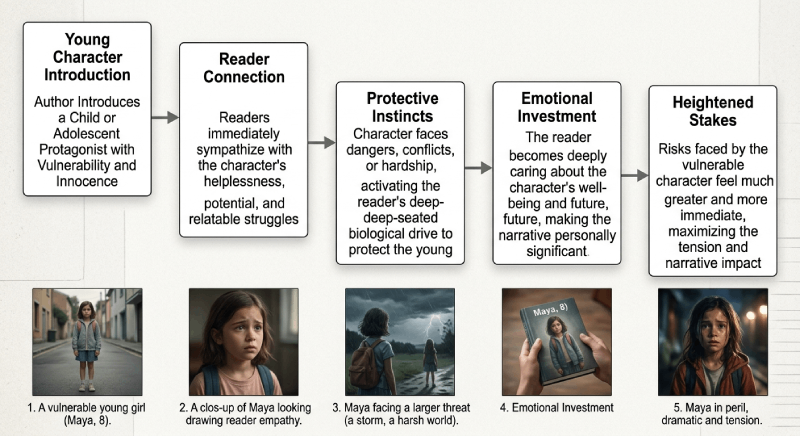
How authors use young characters for emotional impact — innocence, reader connection, protective instincts

AI-generated visual — the emotional mechanics of young characters in storytelling.

Content Connecting to Positive Mentorship

From Fiction to Real Life: Protective Relationships

While the circumstances in The Hunger Games are extreme and fictional, the themes of protection, mentorship, and loyalty appear in positive ways throughout real life. Let’s explore these connections!

Mentorship in Sports:
Think about your own experiences in field hockey and gymnastics:

  • Older players teaching younger teammates proper techniques
  • Experienced athletes protecting newcomers from discouragement
  • Team captains who look out for everyone’s wellbeing
  • Coaches who see potential in young athletes and nurture their growth

What Makes Good Mentorship:

  1. Patience — Understanding that learning takes time
  2. Protection — Shielding others from unnecessary harm or discouragement
  3. Encouragement — Building confidence and belief in abilities
  4. Skill-sharing — Teaching practical knowledge and techniques
  5. Emotional support — Being there during difficult moments

The Katniss-Rue Dynamic in Positive Context:
If we remove the violent arena setting, Katniss and Rue’s relationship shows:

  • An older person recognizing and respecting a younger person’s unique talents
  • Mutual learning (Rue teaches Katniss about the tracker jackers and mockingjays)
  • Protection without condescension (Katniss doesn’t treat Rue as helpless)
  • Genuine friendship that transcends age differences

In K-pop and Entertainment:
Even in K-pop groups, you often see older members (hyungs/unnies) taking care of and mentoring younger members (maknae), creating family-like bonds that help everyone succeed.

These positive examples help us understand that the core human instincts Collins writes about — the desire to protect, teach, and connect with others — are fundamentally good things that make communities stronger! 🌟

An older field hockey player mentoring a younger teammate on the pitch

Positive mentorship in action — the same protective instincts Collins writes about, on the field hockey pitch.

Assessment Character Relationship Analysis

Now it’s time to put your analytical thinking into practice! You’ll write a detailed analysis of the relationship between Katniss and Rue, exploring how their alliance develops and what it reveals about both characters.

Writing Structure Guide:

Paragraph 1 — Introduction (3-4 sentences):

  • Introduce the characters and the situation where they meet
  • State your main point about what their alliance reveals

Paragraph 2 — How the Alliance Forms (4-5 sentences):

  • Describe the specific moments when they begin to trust each other
  • Explain what each character brings to the partnership
  • Include at least one specific example from the text

Paragraph 3 — What Their Friendship Reveals (4-5 sentences):

  • Analyze what their relationship shows about Katniss’s character
  • Discuss what it reveals about Rue’s character
  • Explain how their bond demonstrates human nature under pressure

Paragraph 4 — The Impact and Meaning (3-4 sentences):

  • Discuss how their alliance affects the story’s themes
  • Explain why Collins chose to include this relationship
  • Connect to the larger message about humanity and survival

Writing Tips:

  • Use specific examples from Chapters 12-13
  • Include character names and refer to specific scenes
  • Show how the relationship changes both characters
  • Use your spelling words where they fit naturally (alliance, strategy, survival, instinct, etc.)

Target Length: 14-18 sentences total across 4 paragraphs

Your response
Write your four-paragraph analysis here…
Wrap-up Reflecting on Friendship and Courage

Excellent work today, Kayleigh! 🌟 You’ve tackled some emotionally challenging but important material. You’ve explored how authors create meaningful relationships between characters and how those relationships help us understand deeper themes about human nature.

What You Accomplished:

  • ✅ Read two pivotal chapters that show the power of alliance and friendship
  • ✅ Analyzed how authors use younger characters to create emotional impact
  • ✅ Connected literary themes to positive real-world examples of mentorship
  • ✅ Practiced spelling words related to strategy and survival
  • ✅ Wrote a thoughtful analysis of character relationships

Key Insights to Remember:

  • Alliances in literature reveal important truths about loyalty and human nature
  • Authors use younger characters strategically to heighten emotional stakes
  • The protective instincts we see in fiction mirror positive mentorship in real life
  • Even in difficult circumstances, people can choose kindness and connection

Looking Ahead:
The themes you explored today — loyalty, protection, sacrifice, and the choice to maintain humanity under pressure — will continue to be important as the story progresses. You’re developing strong analytical skills that will help you understand not just this novel, but literature in general.

Remember: the emotional power of these chapters shows Collins’s skill as a writer, and your thoughtful response shows your growth as a reader and thinker. Well done! 💪📚

10Paragraph Transitions and FlowWriting
Learn how to guide readers smoothly between ideas using effective transitions. Practice using transitional words and phrases that show relationships between paragraphs — cause and effect, comparison, sequence, and emphasis. Revise previous writing samples to improve flow and coherence. Use examples from professional writing to see transitions in action.
🔤 Spelling: strategy, alliance, survival, conflict, tension, instinct, decision, pressure, competition, analysis
💡 Use concrete examples and visual organizers to show how transitions work like bridges between ideas. Practice with Kayleigh’s own writing to make it immediately relevant.
🧪 Materials: Transition word lists, previous writing samples for revision
11The Gamemakers’ Feast — Plot Twists and SuspenseQuiz
Read Chapters 14-15 as the rules change and new challenges emerge. Analyze how authors use plot twists to maintain reader interest and create suspense. Examine the concept of dramatic irony — when readers know something characters don’t. Discuss how changing rules affect strategy and character relationships.
🔤 Spelling: dramatic, suspense, strategy, irony, circumstances, adapt, regulations, consequences, emerge, maintain
💡 Connect rule changes to sports where regulations or game conditions change mid-competition. Discuss how athletes adapt strategies when circumstances shift.
🧪 Materials: The Hunger Games, plot analysis chart
12Peeta’s Revelation — Character MotivationWriting
Continue with Chapters 16-17 exploring Peeta’s feelings and the complexity of relationships under extreme circumstances. Analyze character motivation — why characters act as they do and how past experiences shape present choices. Examine how authors reveal character background through dialogue and flashbacks.
🔤 Spelling: dramatic, suspense, strategy, irony, circumstances, adapt, regulations, consequences, emerge, maintain
💡 Focus on how people’s backgrounds influence their choices. Connect to how training and past experiences affect athletic performance and decision-making.
🧪 Materials: The Hunger Games, character motivation worksheet
13Cave Scenes — Vulnerability and TrustLong Writing
Read Chapters 18-19 as Katniss and Peeta shelter together and their relationship deepens. Explore themes of vulnerability, trust, and survival partnerships. Analyze how authors use quiet moments to develop character relationships and provide relief from intense action. Discuss the difference between survival strategy and genuine emotion.
🔤 Spelling: dramatic, suspense, strategy, irony, circumstances, adapt, regulations, consequences, emerge, maintain
💡 Focus on positive examples of trust and teamwork. Connect to partnerships in sports like doubles tennis or relay teams where trust is essential for success.
🧪 Materials: The Hunger Games, relationship analysis chart
Detective Fiction Mini-Unit & Argumentative Writing
14Introduction to Detective Fiction — Sherlock HolmesQuiz
Take a break from The Hunger Games to explore a different narrative style with Arthur Conan Doyle’s ‘A Scandal in Bohemia.’ Compare the logical, methodical approach of detective fiction with the emotional intensity of dystopian survival stories. Examine how different genres use different techniques to engage readers.
🔤 Spelling: dramatic, suspense, strategy, irony, circumstances, adapt, regulations, consequences, emerge, maintain
💡 Emphasize the contrast in pacing and problem-solving approaches. Connect Holmes’s observational skills to the detailed attention required in gymnastics or field hockey.
🧪 Materials: A Scandal in Bohemia text, genre comparison chart
15Deductive Reasoning and EvidenceWriting
Continue with Sherlock Holmes, focusing on how the detective uses observation and logical reasoning to solve mysteries. Practice identifying evidence and drawing logical conclusions. Learn the difference between deductive and inductive reasoning. Apply these thinking skills to analyzing literature and making predictions about plot development.
🔤 Spelling: dramatic, suspense, strategy, irony, circumstances, adapt, regulations, consequences, emerge, maintain
💡 Make reasoning skills concrete through examples. Connect to how athletes analyze opponents’ strategies or how she might solve problems in daily life.
🧪 Materials: Sherlock Holmes story, logic practice exercises
16Back to the Arena — The Final ConfrontationLong Writing
Return to The Hunger Games with Chapters 20-21 as the Games reach their climax. Analyze how authors build to a climax and resolve major conflicts. Examine the role of external forces (the Gamemakers) in shaping the story’s conclusion. Discuss themes of defiance and the power of individual choice against oppressive systems.
🔤 Spelling: defiance, oppressive, individual, climax, resolve, external, conclusion, choice, circumstances, forces
💡 Focus on how individual choices can make a difference even in difficult circumstances. Connect to examples of athletes or performers who stood up for what was right.
🧪 Materials: The Hunger Games, climax analysis worksheet
17The Berries — Symbolism and Theme AnalysisLong Writing
Read Chapters 22-23 focusing on the nightlock berries scene and its symbolic significance. Analyze how symbols carry thematic meaning throughout a story. Examine the concept of rebellion through literature — how characters resist unjust systems. Practice writing thematic analysis paragraphs with clear topic sentences and textual evidence.
🔤 Spelling: defiance, oppressive, individual, climax, resolve, external, conclusion, choice, circumstances, forces
💡 Focus on positive examples of standing up for principles. Connect to examples from sports where athletes have taken principled stands for fairness or safety.
🧪 Materials: The Hunger Games, symbolism analysis chart, writing materials
18Victory and Its Cost — Resolution and ReflectionWriting
Complete The Hunger Games with Chapters 24-27, examining how the story resolves and what questions remain unanswered. Analyze the concept of pyrrhic victory — winning at great cost. Discuss how the ending sets up future conflicts and character development. Reflect on the themes explored throughout the novel.
🔤 Spelling: defiance, oppressive, individual, climax, resolve, external, conclusion, choice, circumstances, forces
💡 Help process the complex emotions of the ending. Focus on growth, resilience, and the importance of maintaining humanity even in difficult circumstances.
🧪 Materials: The Hunger Games, reflection questions, theme summary chart
19Argumentative Essay Introduction — Taking a StandWriting
Learn the structure of argumentative essays by examining a debate topic from The Hunger Games: Was Katniss right to defy the Gamemakers with the berries? Understand the components of a strong argument — claim, evidence, reasoning, and counterarguments. Practice writing clear thesis statements that take a definitive position.
🔤 Spelling: defiance, oppressive, individual, climax, resolve, external, conclusion, choice, circumstances, forces
💡 Start with a topic Kayleigh has strong opinions about from the novel. Emphasize that good arguments consider multiple perspectives before taking a position.
🧪 Materials: Argumentative essay structure guide, thesis statement practice sheet
20Gathering Evidence — Supporting Your ArgumentLong Writing
Practice finding and selecting strong textual evidence to support argumentative claims. Learn the difference between strong and weak evidence, and how to introduce quotes effectively in writing. Use examples from The Hunger Games to practice embedding quotations and explaining their significance to your argument.
🔤 Spelling: defiance, oppressive, individual, climax, resolve, external, conclusion, choice, circumstances, forces
💡 Make evidence selection concrete by comparing it to building a case or proving a point in sports. Show how the best evidence clearly supports the main argument.
🧪 Materials: The Hunger Games, evidence collection worksheet, quotation integration guide
21Poetry of Resistance — Voices of ChangeLong Writing
Explore how poets throughout history have used their voices to challenge injustice and inspire change. Read selected poems about courage, resistance, and standing up for beliefs. Analyze how poetic devices like repetition and imagery create emotional impact. Write a poem inspired by themes from The Hunger Games.
🔤 Spelling: resistance, inspire, injustice, challenge, empowerment, courage, beliefs, repetition, imagery, emotional
💡 Choose uplifting poems that focus on positive change and empowerment. Encourage Kayleigh to write about a time when she or someone she admires showed courage.
🧪 Materials: Poetry anthology, writing materials
22Counterarguments — Strengthening Your PositionWriting
Learn how acknowledging and addressing counterarguments actually strengthens argumentative writing. Practice identifying opposing viewpoints and responding to them respectfully but firmly. Use the Hunger Games debate to practice this skill — what would someone who disagreed with your position say, and how would you respond?
🔤 Spelling: resistance, inspire, injustice, challenge, empowerment, courage, beliefs, repetition, imagery, emotional
💡 Emphasize respectful disagreement and the importance of understanding different perspectives. Connect to sportsmanship and fair play in competition.
🧪 Materials: Counterargument practice sheet, debate preparation guide
23Comparing Heroes — Katniss vs HolmesLong Writing
Compare and contrast the heroic qualities of Katniss Everdeen and Sherlock Holmes. Examine how different genres define heroism and what qualities make characters admirable to readers. Practice writing comparison paragraphs that analyze similarities and differences between literary characters.
🔤 Spelling: resistance, inspire, injustice, challenge, empowerment, courage, beliefs, repetition, imagery, emotional
💡 Help Kayleigh see how heroism takes different forms — physical courage vs intellectual courage, emotional vs logical approaches to problems. Connect to different types of leadership in sports.
🧪 Materials: Character comparison chart, both novels for reference
24Vocabulary in Context — Word Detective WorkQuiz
Practice using context clues to determine word meanings, using challenging vocabulary from both The Hunger Games and Sherlock Holmes stories. Learn different types of context clues — definition, synonym, antonym, example, and inference. Build strategies for tackling unfamiliar words in reading.
🔤 Spelling: resistance, inspire, injustice, challenge, empowerment, courage, beliefs, repetition, imagery, emotional
💡 Make vocabulary work feel like detective work, connecting to Holmes’s observational skills. Use visual organizers to show how context clues work.
🧪 Materials: Vocabulary from recent reading, context clues practice sheet
25Writing Workshop — Argumentative Essay DraftLong Writing
Apply all the argumentative writing skills learned this quarter by drafting a complete essay arguing a position about character choices in The Hunger Games. Focus on clear organization, strong evidence, and addressing counterarguments. Use the writing process — plan, draft, revise — to create a polished piece.
🔤 Spelling: resistance, inspire, injustice, challenge, empowerment, courage, beliefs, repetition, imagery, emotional
💡 Provide plenty of scaffolding for the essay structure. Break the process into manageable steps and celebrate progress at each stage.
🧪 Materials: Essay planning sheet, writing materials, revision checklist
26Quarter Reflection — Growth and DiscoveryWriting
Reflect on the quarter’s learning journey through stories of courage and discovery. Review the themes explored in The Hunger Games and Sherlock Holmes stories. Assess growth in analytical reading, argumentative writing, and literary analysis skills. Set goals for continued improvement in Quarter 2.
🔤 Spelling: resistance, inspire, injustice, challenge, empowerment, courage, beliefs, repetition, imagery, emotional
💡 Focus on growth and improvement rather than perfection. Help Kayleigh identify specific skills she’s developed and areas where she wants to continue growing.
🧪 Materials: Portfolio of quarter’s work, reflection questions, goal-setting worksheet

Units: Cell Biology → Genetics & DNA → Human Body Systems

Labs: Kitchen science (onion/cheek cells), heart rate lab, lung capacity measurement

Connections: Athletic performance tied to body systems, equestrian science, sports physiology

Cell Biology Basics
01The Hidden World: Introduction to CellsWriting
Discover the amazing world that exists all around us but remains invisible to our eyes. We’ll explore what cells are, why they’re called the ‘building blocks of life,’ and connect this to things you see every day — from the muscles that help you vault in gymnastics to the way horses’ bodies work.
Cell Biology Basics
02Microscope Mastery: Your Window to the InvisibleEvidence
Learn to use your microscope like a professional scientist. We’ll start with prepared slides to see actual cells for the first time, practice proper focusing techniques, and create detailed scientific drawings of what we observe.
🧪 Materials: Microscope (40x-400x), Prepared slide set (cells, tissues), Lab notebook (graph paper), Pencils for scientific drawing
Microscope Skills
03Plant vs Animal Cells: Spotting the DifferencesQuiz
Dive deeper into the fascinating differences between plant and animal cells. We’ll explore why plant cells have walls while animal cells don’t, and how these differences relate to the different jobs plants and animals do in the world.
Cell Types and Structures
04Kitchen Science: Observing Onion and Cheek CellsEvidence
Prepare your own slides using cells from an onion and from inside your cheek. This hands-on lab will let you see living cells up close and compare what you observe with the prepared slides from our previous lab.
🧪 Materials: Microscope (40x-400x), Onion, Cotton swabs, Microscope slides and cover slips, Water, Lab notebook (graph paper)
Live Cell Observation
05Cell Organelles: The Tiny Machines InsideWriting
Explore the amazing ‘machines’ inside every cell that keep life running smoothly. We’ll discover how the nucleus acts like a control center, how mitochondria power cellular activities, and connect this to the energy systems that fuel athletic performance.
Cell Organelles and Functions
06Cell Theory and the History of DiscoveryQuiz
Learn about the scientists who first discovered cells and developed our understanding of cellular life. We’ll explore the three main principles of cell theory and see how scientific knowledge builds over time through curiosity and careful observation.
Cell Theory
07Cell Biology Unit AssessmentUnit Test
Demonstrate your understanding of cell biology concepts through a comprehensive assessment covering cell structures, functions, and the use of microscopes in scientific observation.
Cell Biology Review
Genetics & DNA
08The Blueprint of Life: Introduction to GeneticsWriting
Discover why you have your mom’s eyes or your dad’s height. We’ll explore how traits are passed from parents to children and why siblings can look so different even though they share the same parents. Connect this to horse breeding and athletic abilities that run in families.
Introduction to Genetics
09DNA: The Instruction Manual for LifeQuiz
Explore the amazing molecule that contains the instructions for building every living thing. We’ll learn about DNA structure, how it’s organized in chromosomes, and why it’s often called the ‘blueprint of life.’
DNA and Chromosomes

Session 09 — DNA: The Instruction Manual for Life

Full generated lesson
Intro Welcome to DNA Discovery! 🧬

Hey Kayleigh! Today we’re diving into one of the most incredible discoveries in science — DNA! 🧬 You’ve probably heard this term before, but today you’ll understand exactly what it is and why it’s so amazing.

Think about this: every single living thing on Earth — from the tiniest bacteria to the largest whale, from a blade of grass to you — all contain the same type of instruction manual. That instruction manual is DNA, and it contains the directions for building and running every living organism.

Today you’ll discover:

  1. What DNA actually looks like and how it’s structured
  2. How DNA is organized inside your cells
  3. Why scientists call DNA the “blueprint of life”
  4. How DNA determines your traits and characteristics
  5. What makes DNA so special across all living things

Get ready to explore the molecular world that makes life possible! 🔬✨

Content The Amazing Structure of DNA

CrashCourse — DNA Structure and Replication (13 min)

DNA stands for deoxyribonucleic acid — quite a mouthful! But don’t worry about memorizing that long name. What’s important is understanding what DNA looks like and how it works.

The Double Helix Shape

Imagine a twisted ladder or a spiral staircase. That’s exactly what DNA looks like! Scientists call this shape a double helix. The “double” part means there are two strands, and “helix” means it’s twisted like a spiral.

The sides of this twisted ladder are made of sugar and phosphate molecules — think of them as the rails of the ladder. The “rungs” or steps of the ladder are made of special chemicals called bases. There are only four types of bases in DNA:

  1. Adenine (A) — always pairs with Thymine
  2. Thymine (T) — always pairs with Adenine
  3. Guanine (G) — always pairs with Cytosine
  4. Cytosine (C) — always pairs with Guanine

These bases are like letters in an alphabet, but instead of 26 letters, DNA only uses 4 letters: A, T, G, and C. The amazing thing is that these four simple letters can create the instructions for every living thing on Earth!

Base Pairing Rules

The bases follow strict pairing rules — A always connects to T, and G always connects to C. This is like having puzzle pieces that only fit together in certain ways. This pairing system is crucial because it allows DNA to copy itself perfectly.

A single DNA molecule can contain millions or even billions of these base pairs. The sequence (order) of these bases is what makes each organism unique. It’s like having a book where the order of letters determines whether you’re reading a recipe, a poem, or a story!

Content How DNA is Organized in Your Cells

Now that you know what DNA looks like, let’s explore how this incredibly long molecule fits inside your tiny cells!

From DNA to Chromosomes

If you could stretch out all the DNA from just one of your cells, it would be about 6 feet long! But your cells are microscopic. How does 6 feet of DNA fit into something so small? The answer is amazing organization and packaging.

Here’s how it works, step by step:

  1. DNA wraps around proteins called histones, like thread wrapping around a spool
  2. This wrapped DNA forms structures called chromatin
  3. Chromatin condenses (squishes together) to form visible chromosomes
  4. Chromosomes are stored in the nucleus of your cell

Your Chromosome Collection

Humans have 46 chromosomes in most of their cells. These chromosomes come in 23 pairs — you got one chromosome from each pair from your mom, and one from your dad. That’s why you might have your mom’s eyes but your dad’s nose!

Each chromosome contains hundreds or thousands of genes. A gene is a specific section of DNA that contains the instructions for making one particular protein. Think of genes as individual recipes in a massive cookbook.

Different Cells, Same DNA

Here’s something mind-blowing: every cell in your body (except red blood cells) contains exactly the same DNA! Your skin cells have the same DNA as your brain cells, your muscle cells, and your heart cells. The difference is which genes are “turned on” or “turned off” in each type of cell.

It’s like having the same cookbook in every room of your house, but only using the dessert recipes in the kitchen and only using the cleaning recipes in the laundry room. Same book, different sections being used!
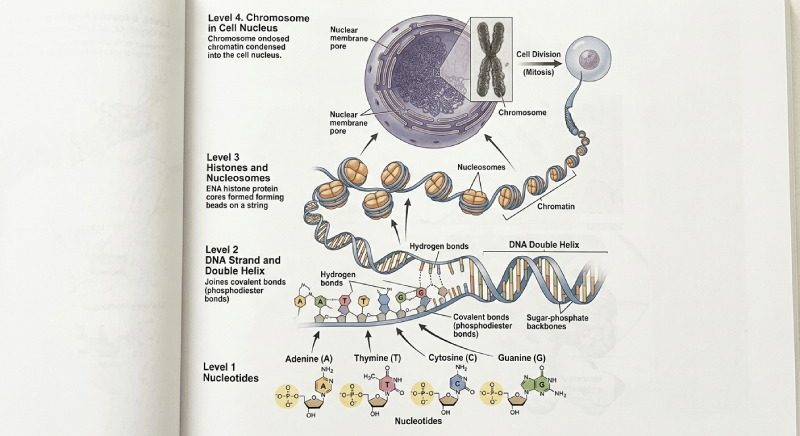
DNA packaging — from double helix to chromatin to chromosome inside the cell nucleus

How 6 feet of DNA fits inside a microscopic cell — from double helix to chromosome.

Content DNA: The Blueprint of Life

You’ve probably heard DNA called the “blueprint of life,” but what does that really mean? Let’s break down this important concept!

What is a Blueprint?

A blueprint is a detailed plan that shows exactly how to build something. Architects use blueprints to show builders how to construct a house — where every wall goes, how big each room should be, where to put the windows and doors.

DNA works exactly the same way, but instead of building houses, it provides the plans for building living organisms!

How DNA Gives Instructions

Remember those four bases (A, T, G, C)? The sequence of these bases creates a code — kind of like Morse code, but using four symbols instead of dots and dashes. This genetic code tells your cells:

  1. What proteins to make — Proteins do most of the work in your body
  2. When to make them — Some proteins are needed all the time, others only sometimes
  3. How much to make — Your body needs different amounts of different proteins
  4. Where to use them — Different proteins work in different parts of your body

From Code to Characteristics

The proteins that your DNA codes for determine everything about you:

  1. Physical traits: Height, eye color, hair texture, skin tone
  2. Body functions: How fast your heart beats, how well you digest food
  3. Special abilities: Some people can roll their tongues, others can’t
  4. Disease resistance: Why some people rarely get sick

The Universal Code

Here’s something amazing: the genetic code is nearly identical in all living things! The same A-T-G-C system that works in humans also works in plants, animals, bacteria, and fungi. It’s like all of life uses the same basic programming language.

This is why scientists can study diseases in mice and apply what they learn to humans, or why we can use bacteria to produce human medicines. We’re all using the same fundamental instruction system!

Content How DNA Determines Your Unique Traits

Now let’s explore how the instructions in your DNA actually create the traits that make you uniquely you!

Genes: Individual Instructions

Each gene is like a single recipe in your DNA cookbook. Humans have about 20,000-25,000 genes, and each one contains instructions for making a specific protein. These proteins then work together to create your traits.

For example:

  1. Eye color genes make proteins that produce and distribute pigments in your iris
  2. Height genes make proteins that control bone growth and development
  3. Hair texture genes make proteins that determine the shape of your hair follicles

Dominant and Recessive Traits

Remember, you have two copies of each gene — one from your mom and one from your dad. Sometimes these copies give the same instructions, but sometimes they give different instructions!

Dominant traits are like loud voices — they get heard even if there’s only one copy. Examples include:

  1. Brown eyes (dominant over blue eyes)
  2. Dark hair (dominant over light hair)
  3. Ability to roll your tongue

Recessive traits are like quiet voices — you need two copies for them to be expressed. Examples include:

  1. Blue eyes
  2. Red hair
  3. Inability to roll your tongue

Environmental Influences

Your DNA provides the basic instructions, but your environment can influence how those instructions are carried out. Think of it like this:

  1. Your genes might give you the potential to be tall
  2. Your nutrition during childhood affects whether you reach that potential
  3. Your genes determine your natural hair color
  4. Sun exposure might lighten it or you might choose to dye it

Mutations: Changes in the Code

Sometimes, the DNA code gets changed slightly — these changes are called mutations. Most mutations are harmless or even beneficial! For example:

  1. Lactose tolerance — Most mammals lose the ability to digest milk as adults, but some humans have a mutation that lets them continue digesting dairy
  2. Sickle cell trait — In areas with malaria, having one copy of this mutation actually provides protection against the disease

Mutations are one way that species evolve and adapt over time. They’re a natural part of life and help explain the incredible diversity we see in the living world!
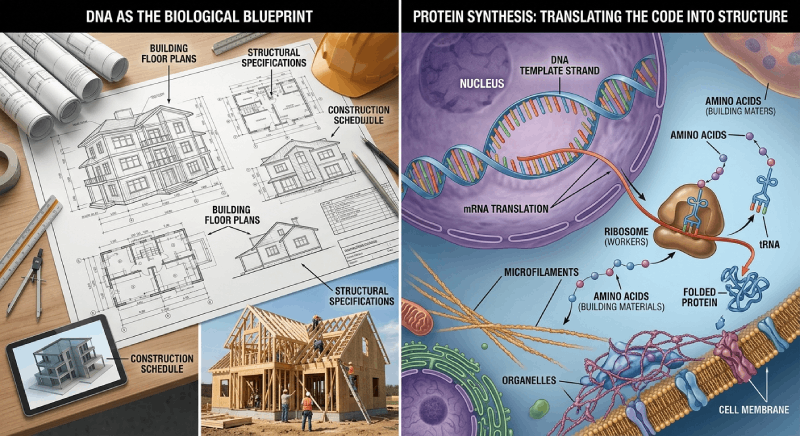
DNA as a biological blueprint — comparing architectural plans to protein synthesis

DNA as blueprint — just like architectural plans guide construction, DNA guides protein synthesis.

Content DNA Across All Living Things

One of the most amazing things about DNA is how it connects all life on Earth. Let’s explore what makes DNA universal and what makes each species unique!

The Universal Genetic Code

Every living thing on Earth — from the bacteria in your gut to the giant sequoia trees in California — uses the same basic genetic code. They all use the same four bases (A, T, G, C) and the same rules for turning that code into proteins.

This tells us something incredible: all life on Earth is related. We all share common ancestors from billions of years ago!

Similarities in DNA

You might be surprised by how similar your DNA is to other organisms:

  1. Chimpanzees: 98.8% identical to human DNA
  2. Mice: About 95% identical to human DNA
  3. Fruit flies: About 60% identical to human DNA
  4. Bananas: About 50% identical to human DNA
  5. E. coli bacteria: About 7% identical to human DNA

These similarities exist because we share many of the same basic life processes — we all need to make proteins, store energy, and reproduce.

What Makes Each Species Unique

If we share so much DNA, what makes each species different? Several factors:

  1. Chromosome number: Humans have 46 chromosomes, dogs have 78, and some plants have over 1,000!
  2. Gene arrangement: The same genes might be in different orders
  3. Regulatory sequences: Different instructions about when and where to use genes
  4. Unique genes: Some genes are found only in certain species

DNA and Evolution

DNA is like a history book that tells the story of evolution. Scientists can compare DNA from different species to:

  1. Determine relationships: Which species are most closely related
  2. Track evolution: How species changed over time
  3. Understand adaptation: How organisms adapted to different environments
  4. Predict the future: How species might respond to environmental changes

Conservation and DNA

Understanding DNA helps us protect endangered species. Scientists can:

  1. Identify genetic diversity: Healthy populations need genetic variety
  2. Track populations: Use DNA like fingerprints to count animals
  3. Plan breeding programs: Ensure genetic health in captive populations
  4. Solve wildlife crimes: Use DNA evidence to catch poachers

The more we learn about DNA, the more we understand how interconnected all life really is. We’re all part of one amazing, complex family tree that stretches back billions of years!

Assessment Quiz Time!

Let’s see what you learned! Answer the following questions.

Q1: What shape is DNA and what are the “rungs” of this structure made of?
Q2: How many chromosomes do humans have in most of their cells, and where do they come from?
Q3: Why is DNA called the “blueprint of life”?
Q4: What is the difference between dominant and recessive traits?
Q5: What does the fact that humans share about 50% of their DNA with bananas tell us?
Wrap-up Congratulations, DNA Detective! 🧬🏆

Amazing work today, Kayleigh! You’ve just learned about one of the most important discoveries in all of science. Let’s recap what you now understand:

  • DNA Structure: You know DNA is shaped like a twisted ladder (double helix) made of four bases: A, T, G, and C
  • Cell Organization: You understand how 6 feet of DNA fits into tiny cells through amazing packaging into chromosomes
  • Life’s Blueprint: You can explain why DNA is called the blueprint of life and how it codes for proteins
  • Your Unique Traits: You know how genes determine your characteristics and how dominant/recessive traits work
  • Universal Connection: You understand how DNA connects all living things while making each species unique

You’re now equipped with knowledge that helps explain everything from why you have your eye color to how scientists study evolution and protect endangered species. This understanding of DNA is fundamental to modern biology, medicine, and conservation.

Next time you look in the mirror, remember that you’re seeing the result of billions of years of evolution and the incredible molecular machinery working inside every one of your cells! 🌟

Great job being such an engaged science student today! 🔬✨

10Chromosome Safari: Observing Genetic MaterialEvidence
Use your microscope to observe prepared slides showing chromosomes during cell division. We’ll see the actual structures that carry genetic information and learn how scientists study heredity at the cellular level.
🧪 Materials: Microscope (40x-400x), Prepared slides showing cell division and chromosomes, Lab notebook (graph paper), Colored pencils for detailed drawings
Chromosome Observation
11Mendel’s Pea Plants: The Father of GeneticsWriting
Meet Gregor Mendel, the monk whose curiosity about pea plants led to our understanding of how traits are inherited. We’ll explore his experiments and discover the patterns he found that still help us predict inheritance today.
Mendel and Basic Inheritance
12Punnett Squares: Predicting Genetic OutcomesEvidence
Learn to use Punnett squares like a genetic fortune teller! We’ll practice predicting what traits offspring might inherit using real examples from horse breeding, human traits, and other organisms you’re familiar with.
🧪 Materials: Lab notebook (graph paper), Colored pencils or markers, Trait cards showing various characteristics, Calculator
Punnett Square Practice
13Family Trees and Trait TrackingQuiz
Create family trees that show how traits travel through generations. We’ll explore how scientists track genetic conditions and traits through families, and you’ll analyze inheritance patterns in both human families and animal breeding programs.
Pedigrees and Inheritance Patterns
14Modern Genetics: Beyond Mendel’s GardenWriting
Discover how genetics has evolved far beyond Mendel’s simple pea plant experiments. We’ll explore complex inheritance patterns, genetic engineering, and how understanding genetics helps in medicine, agriculture, and conservation efforts.
Complex Inheritance and Modern Applications
15Genetics Unit AssessmentUnit Test
Demonstrate your mastery of genetic concepts through a comprehensive assessment covering inheritance patterns, Punnett squares, and the relationship between DNA, chromosomes, and heredity.
Genetics Review
Human Body Systems
16Your Amazing Body: Introduction to Human SystemsWriting
Discover the incredible machine that is your body! We’ll explore how different body systems work together to support everything you do — from scoring goals in field hockey to executing perfect gymnastics routines. Learn why your body is more amazing than any technology humans have ever created.
Body Systems Overview
17Heart Rate Lab: Your Body’s Response to ActivityEvidence
Investigate how your cardiovascular system responds to different levels of activity. We’ll measure heart rate during rest, moderate activity, and intense exercise, then analyze the data to understand how your heart adapts to meet your body’s changing needs.
🧪 Materials: Stopwatch or timer, Lab notebook (graph paper), Calculator, Space for physical activity (jumping jacks, etc.)
Cardiovascular System Investigation
18Breathing and Lung Capacity: The Respiratory System at WorkEvidence
Explore how your respiratory system delivers oxygen to your body and removes carbon dioxide. We’ll measure lung capacity, observe breathing patterns during different activities, and understand why proper breathing technique is crucial for athletic performance.
🧪 Materials: Large measuring container, Water, Flexible tubing, Balloons, Measuring tape, Lab notebook (graph paper)
Respiratory System Investigation

Units: The Renaissance → The Reformation → Age of Exploration

Approach: Mixed depth — broad surveys with deep-dives into key figures. Socratic questioning and primary source analysis.

Connections: Renaissance music and performance tied to K-pop culture, Indigenous perspectives on contact and colonization

The Renaissance
01Renaissance Awakening: When Europe Rediscovered WonderWriting
Journey to 1400s Italy where artists, inventors, and thinkers broke free from medieval traditions. Discover why this period was called a ‘rebirth’ and how it changed everything from art to science to how people saw themselves.
02Leonardo da Vinci: The Ultimate Renaissance MindQuiz
Meet history’s most famous polymath who painted the Mona Lisa, designed flying machines, and studied human anatomy. Explore how Leonardo embodied the Renaissance ideal of curiosity about everything.
03Michelangelo and the Art RevolutionWriting
Discover how Michelangelo transformed sculpture and painting, creating masterpieces like David and the Sistine Chapel ceiling. Learn how Renaissance artists used new techniques to make art more lifelike than ever before.
04The Printing Press: How Gutenberg Changed the WorldQuiz
Explore how Johannes Gutenberg’s printing press revolutionized communication, making books affordable and spreading Renaissance ideas across Europe faster than ever before.
05Renaissance Music and Performance: The K-pop ConnectionWriting
Discover how Renaissance courts created elaborate musical performances and how patronage supported artists. Connect Renaissance entertainment culture to modern K-pop production and fan culture.
06Renaissance Unit AssessmentUnit Test
Comprehensive assessment covering Renaissance art, science, culture, and key figures including Leonardo da Vinci, Michelangelo, and the impact of the printing press.
The Reformation
07Martin Luther: The Monk Who Challenged an EmpireWriting
Meet the German monk whose 95 Theses sparked the Protestant Reformation. Discover why Luther questioned the Catholic Church and how his ideas spread like wildfire across Europe.
08The Catholic Counter-Reformation: Fighting BackQuiz
Explore how the Catholic Church responded to Protestant challenges through the Council of Trent, new religious orders like the Jesuits, and the Roman Inquisition.
09Religious Wars: When Faith Became WarfareWriting
Examine how religious differences led to devastating wars across Europe, including the French Wars of Religion and the Thirty Years’ War that reshaped the continent.
10Henry VIII and the English ReformationQuiz
Discover how King Henry VIII’s desire for a male heir led to England breaking from Rome and establishing the Church of England, changing English society forever.

Session 10 — Henry VIII and the English Reformation

Full generated lesson
Intro Welcome to Tudor England

Hi Kayleigh! 👑 Today we’re traveling back to 16th century England to meet one of history’s most famous (and infamous) kings — Henry VIII. You’ve probably heard about him having six wives, but there’s so much more to his story!

Today you’ll discover how Henry’s personal problems led to one of the biggest religious changes in English history. We’ll explore:

  1. Who Henry VIII was and why he desperately wanted a son
  2. His six marriages and their dramatic outcomes
  3. How his divorce problems led to breaking with the Catholic Church
  4. The creation of the Church of England
  5. How these changes affected ordinary English people

Get ready to dive into a world of royal drama, religious revolution, and political power plays that changed England forever! 🏰

Content Meet King Henry VIII

History Matters — The Early Tudors: Henry VIII and the Church of England (10 min)

Henry VIII ruled England from 1509 to 1547 — that’s 38 years on the throne! When he became king at age 17, he was young, athletic, and considered very handsome. He loved sports, music, and dancing. But Henry had one overwhelming obsession that would shape his entire reign: he desperately needed a male heir.

Why was having a son so important?

In Tudor England, people believed that only men could rule effectively. Henry’s father, Henry VII, had fought a civil war to become king, and the Tudor family’s claim to the throne wasn’t completely secure. Without a son to inherit, Henry feared England might fall into civil war again after his death.

Henry had seen what happened when there was no clear male heir — chaos, fighting, and instability. He was determined that wouldn’t happen to England under his rule.

The Pressure Builds

Henry married his first wife, Catherine of Aragon, in 1509. She was a Spanish princess and had actually been married to Henry’s older brother Arthur, who died young. Catherine and Henry were married for over 20 years, but their only surviving child was a daughter, Mary. Henry became increasingly frustrated and convinced that God was punishing him for marrying his brother’s widow.

By the 1520s, Henry was also infatuated with a young woman at court named Anne Boleyn. She refused to become his mistress and insisted she would only be his wife. This set the stage for a conflict that would change English history forever.

Content The Six Wives and Their Fates

Henry’s quest for a male heir led him to marry six different women. Each marriage tells a story of hope, disappointment, and often tragedy. Here’s what happened to each wife:

1. Catherine of Aragon (married 1509-1533)

  • Spanish princess, very religious and dignified
  • Had one surviving daughter: Mary
  • Henry divorced her when she couldn’t produce a male heir
  • She refused to accept the divorce and died in exile

2. Anne Boleyn (married 1533-1536)

  • English noblewoman, intelligent and ambitious
  • Had one daughter: Elizabeth (who became Elizabeth I!)
  • When she also failed to produce a son, Henry had her executed for treason
  • She was beheaded at the Tower of London

3. Jane Seymour (married 1536-1537)

  • Quiet, gentle personality — Henry’s favorite wife
  • Finally gave Henry his son: Edward
  • Died from complications after childbirth
  • Henry was genuinely heartbroken by her death

4. Anne of Cleves (married January-July 1540)

  • German princess chosen for political alliance
  • Henry found her unattractive and divorced her quickly
  • She accepted the divorce gracefully and lived comfortably in England
  • Called “the King’s beloved sister” after their divorce

5. Catherine Howard (married 1540-1542)

  • Young, pretty, but inexperienced teenager
  • Had romantic relationships before and possibly during her marriage
  • Henry had her executed for adultery
  • She was only about 19 when she died

6. Catherine Parr (married 1543-1547)

  • Intelligent, well-educated widow
  • Survived Henry and became a successful author
  • Helped reconcile Henry with his daughters Mary and Elizabeth
  • The only wife to outlive the king
Remember this rhyme: “Divorced, beheaded, died, divorced, beheaded, survived!”
Henry VIII's six wives timeline — portraits and fates from Catherine of Aragon to Catherine Parr

The six wives of Henry VIII — their portraits and fates, 1509–1547.

Content Breaking with Rome

Henry’s marriage problems created a massive religious crisis. To understand why, you need to know how marriage and divorce worked in the 1500s.

The Catholic Church’s Power

In Henry’s time, England was a Catholic country. The Catholic Church, led by the Pope in Rome, controlled all religious matters, including marriage and divorce. According to Catholic teaching, marriage was a sacred bond that could never be broken. The Church did not allow divorce.

The only way to end a marriage was through an annulment — a declaration that the marriage had never been valid in the first place. But getting an annulment required the Pope’s permission, and the Pope rarely granted them.

Henry’s Great Matter

When Henry wanted to divorce Catherine of Aragon to marry Anne Boleyn, he asked Pope Clement VII for an annulment. Henry argued that his marriage to Catherine was invalid because she had been married to his brother first, and the Bible forbade such marriages.

But Pope Clement VII refused! Why? Several reasons:

  1. Political pressure: Catherine’s nephew was the powerful Holy Roman Emperor Charles V, who had great influence over the Pope
  2. Religious principle: The Church had originally approved Henry’s marriage to Catherine
  3. Papal authority: Granting the annulment would suggest the Pope had made an error before

Henry’s Revolutionary Decision

Faced with the Pope’s refusal, Henry made a shocking decision: he would break England’s ties with the Catholic Church entirely! In 1534, Parliament passed the Act of Supremacy, which declared:

  1. The King, not the Pope, was the head of the Church in England
  2. England would no longer obey papal authority
  3. Henry could grant his own divorce

This was revolutionary! For over 1,000 years, England had been part of the Catholic Church. Now Henry was creating an entirely new religious system to solve his personal problem.
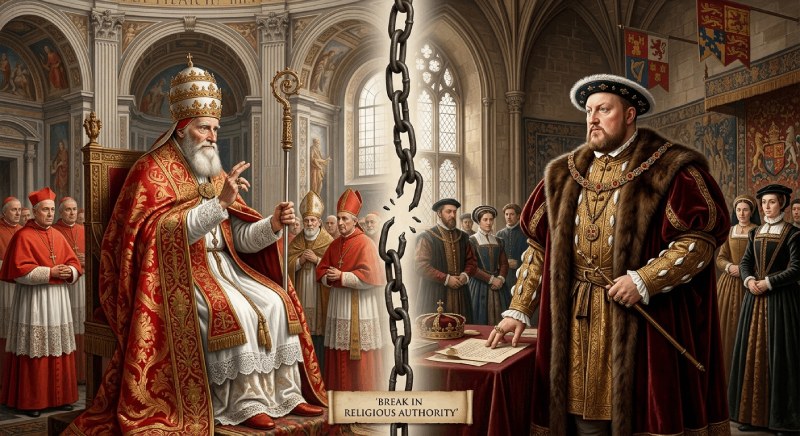
Henry VIII confronts the Pope — the break with Rome that created the Church of England

The confrontation that changed England forever — Henry VIII breaks with papal authority.

Content The Church of England is Born

When Henry broke with Rome, he didn’t just get his divorce — he created an entirely new church: the Church of England (also called the Anglican Church). But what exactly did this new church believe and practice?

Similarities to Catholicism

Surprisingly, Henry’s new church kept many Catholic traditions:

  1. Similar ceremonies: Baptisms, weddings, and funerals remained largely the same
  2. Bishops and priests: The church structure stayed similar
  3. Core beliefs: Most Christian doctrines remained unchanged
  4. Beautiful churches: The same magnificent cathedrals continued to be used

Key Differences

  1. Head of the Church: The English monarch (starting with Henry), not the Pope
  2. Language: Services conducted in English, not Latin, so ordinary people could understand
  3. Married clergy: Priests could marry and have families
  4. Bible access: English translations of the Bible became available to everyone
  5. Simplified practices: Some Catholic rituals were eliminated

The Book of Common Prayer

Under Henry’s son Edward VI, the Church of England developed its own prayer book written in beautiful English. This book standardized Anglican worship and included prayers that are still used today.

A Political Church

The Church of England was as much about politics as religion. By controlling the church, English monarchs gained:

  1. Independence from foreign papal influence
  2. Wealth from church lands and taxes
  3. Power to appoint bishops and control religious teaching
  4. National unity under royal leadership

This created a uniquely English form of Christianity that balanced Catholic traditions with Protestant reforms. The Church of England became a “middle way” between Catholicism and more radical Protestant churches.

Royal Control Continues

To this day, the British monarch is still the official head of the Church of England. When Queen Elizabeth II died in 2022, King Charles III automatically became the church’s Supreme Governor — a title that traces directly back to Henry VIII’s break with Rome nearly 500 years ago!

Content The Dissolution of the Monasteries

One of the most dramatic consequences of Henry’s break with Rome was the Dissolution of the Monasteries (1536-1541). This massive operation changed the English landscape forever and showed just how far Henry was willing to go.

What Were Monasteries?

Monasteries were religious communities where monks lived, prayed, and worked. Convents housed nuns. These institutions had existed in England for over 1,000 years and played crucial roles:

  1. Spiritual centers: Places of prayer and religious devotion
  2. Educational hubs: Many monasteries ran schools and copied books
  3. Healthcare providers: Monks and nuns cared for the sick and poor
  4. Economic powerhouses: They owned vast amounts of land and wealth
  5. Cultural preservers: They maintained libraries and artistic traditions

Why Did Henry Dissolve Them?

Henry had several motives for closing the monasteries:

  1. Money: The royal treasury was nearly empty, and monasteries controlled about 25% of England’s land
  2. Control: Monasteries owed loyalty to the Pope, making them potential centers of resistance
  3. Reform: Some monasteries had become corrupt or lazy in their religious duties
  4. Political support: Henry could reward loyal nobles with former monastery lands

The Process of Dissolution

Henry’s officials, led by Thomas Cromwell, systematically closed monasteries across England:

  1. Inspections: Royal commissioners visited monasteries to find evidence of wrongdoing
  2. Smaller houses first: Monasteries with fewer than 12 residents were closed first (1536)
  3. Forced surrenders: Larger monasteries were pressured to “voluntarily” surrender to the king
  4. Final closures: By 1541, all English monasteries had been dissolved

What Happened to the Wealth?

The dissolution created enormous wealth for Henry:

  1. Land: Thousands of acres were seized and sold to nobles and merchants
  2. Treasure: Gold, silver, and jewels were melted down for the royal treasury
  3. Buildings: Some became private homes, others were demolished for building materials
  4. Books: Priceless manuscripts were often destroyed or sold as scrap

Human Cost

Thousands of monks and nuns suddenly found themselves homeless:

  1. Pensions: Some received small annual payments
  2. New careers: Many former monks became parish priests
  3. Poverty: Others struggled to survive without their religious communities
  4. Lost services: Poor people lost important sources of charity and healthcare

Lasting Impact

The dissolution permanently changed England:

  1. New nobility: Wealthy merchants bought former church lands and became powerful landowners
  2. Economic growth: Land sales stimulated commerce and agriculture
  3. Cultural loss: Centuries of religious art, books, and traditions were destroyed
  4. Social change: The old medieval world of powerful monasteries was gone forever

Many of England’s most beautiful ruins today — like Tintern Abbey and Fountains Abbey — are the remains of monasteries destroyed during Henry’s dissolution. They stand as monuments to one of the most dramatic religious and social transformations in English history.

Assessment Quiz Time!

Let’s see what you learned! Answer the following questions.

Q1: What was King Henry VIII’s main obsession that drove most of his major decisions?
Q2: What happened to Henry VIII’s six wives in order?
Q3: Why did Pope Clement VII refuse to grant Henry VIII an annulment from Catherine of Aragon?
Q4: What was the most important difference between the new Church of England and the Catholic Church?
Q5: What was the main reason Henry VIII dissolved the monasteries?
Wrap-up The King Who Changed Everything

Fantastic work today, Kayleigh! 🎉 You’ve just explored one of the most dramatic periods in English history. Let’s recap what you’ve learned:

  • Henry VIII’s character: A powerful king obsessed with getting a male heir
  • The six wives: Their stories of hope, tragedy, and survival
  • The break with Rome: How personal problems led to religious revolution
  • Church of England: The birth of a new English church
  • Monastery dissolution: The dramatic social and economic changes

Henry VIII’s reign shows us how one person’s decisions can change an entire nation. His quest for a son led to:

  1. England becoming Protestant instead of Catholic
  2. The English monarchy gaining unprecedented power
  3. Massive social and economic upheaval
  4. A new English church that still exists today

Think about this: Henry never got the strong male heir he desperately wanted. His son Edward died young, and England’s greatest monarch turned out to be his daughter Elizabeth I — one of the women he never thought could rule effectively!

Next time, we’ll explore what happened after Henry’s death and how his religious changes affected ordinary English people. Great job today! 👑📚

11Reformation Unit AssessmentUnit Test
Comprehensive assessment covering the Protestant Reformation, Catholic Counter-Reformation, religious wars, and the English Reformation including key figures and their impact.
The Age of Exploration
12Columbus and the Voyage That Changed Two WorldsWriting
Follow Christopher Columbus on his 1492 voyage across the Atlantic. Examine both the European perspective of discovery and the indigenous perspective of invasion.
13Conquistadors and Empires: Cortés and the AztecsQuiz
Witness the dramatic encounter between Hernán Cortés and the Aztec Empire. Explore how a small group of Spanish conquistadors conquered the mighty Aztec civilization.
14The Columbian Exchange: Trading More Than GoldLong Writing
Discover how the encounter between Europe and the Americas created the greatest exchange of plants, animals, diseases, and cultures in human history, reshaping both continents forever.
15Mapping New Worlds: Explorers and NavigationQuiz
Learn how European explorers navigated unknown oceans using new technologies like the compass, astrolabe, and improved maps. Discover the courage and skill required for oceanic exploration.
16Indigenous Voices: Life Before and After ContactWriting
Explore the rich civilizations of the Americas before European contact, including the Inca, Maya, and various North American peoples, and examine how their lives changed after 1492.
17Exploration Unit AssessmentUnit Test
Comprehensive assessment covering the Age of Exploration, including Columbus’s voyages, Spanish conquistadors, the Columbian Exchange, and the impact on indigenous peoples.
18Quarter Review: Courage and Discovery ConnectionsLong Writing
Connect the themes of courage and discovery across the Renaissance, Reformation, and Age of Exploration. Reflect on how questioning authority and embracing curiosity changed the world.

This took zero hours of lesson prep.

A parent entered some info and picked two courses. That's it.

Start for Free